Fernie, Ski Hill, Sparwood, Tie & Rosen Lakes, South Country & Koocanusa Real Estate and Community News

Oct. 21, 2026

First-Time Home Buyer in Fernie: A Practical 2026 Roadmap

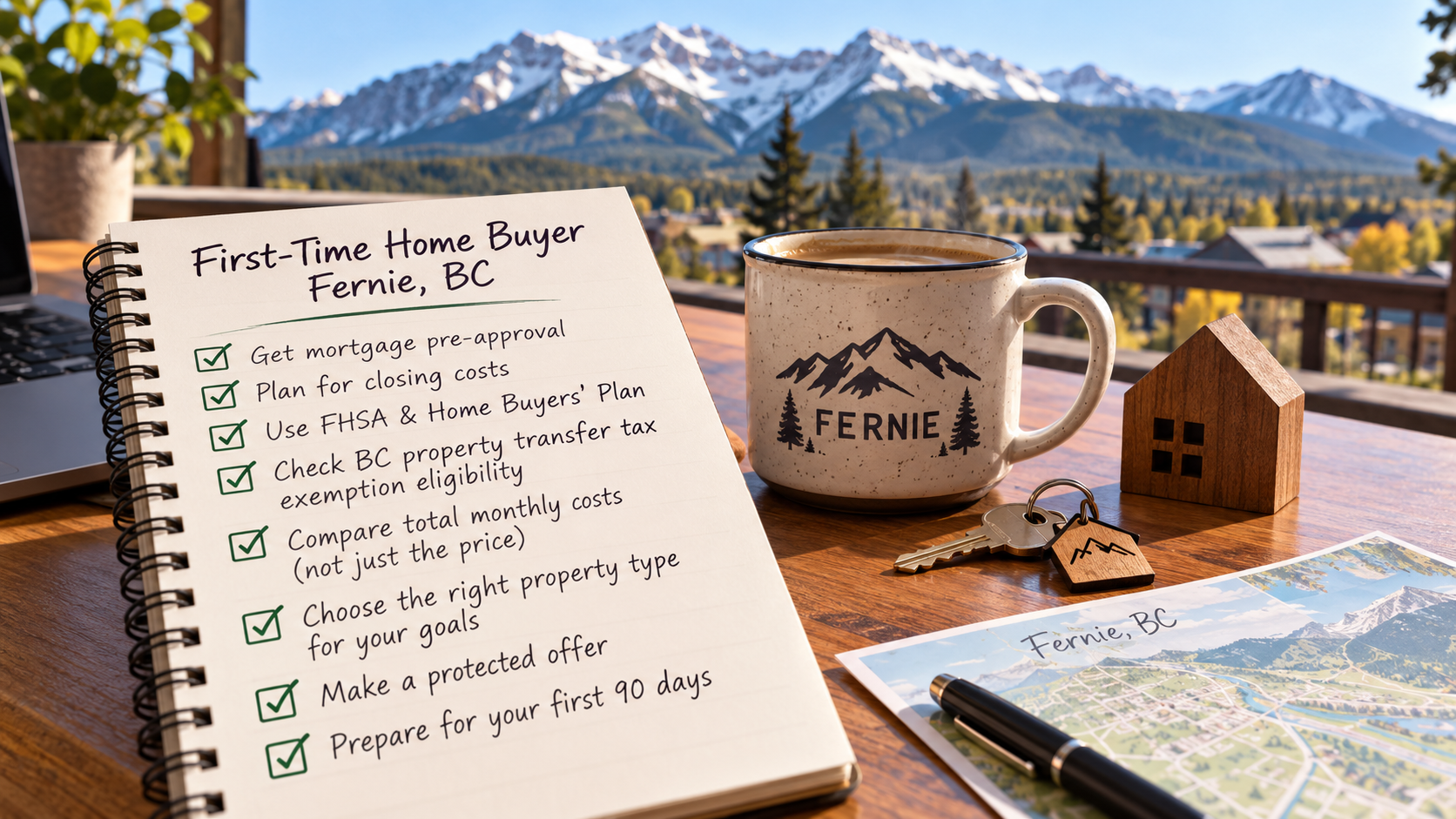
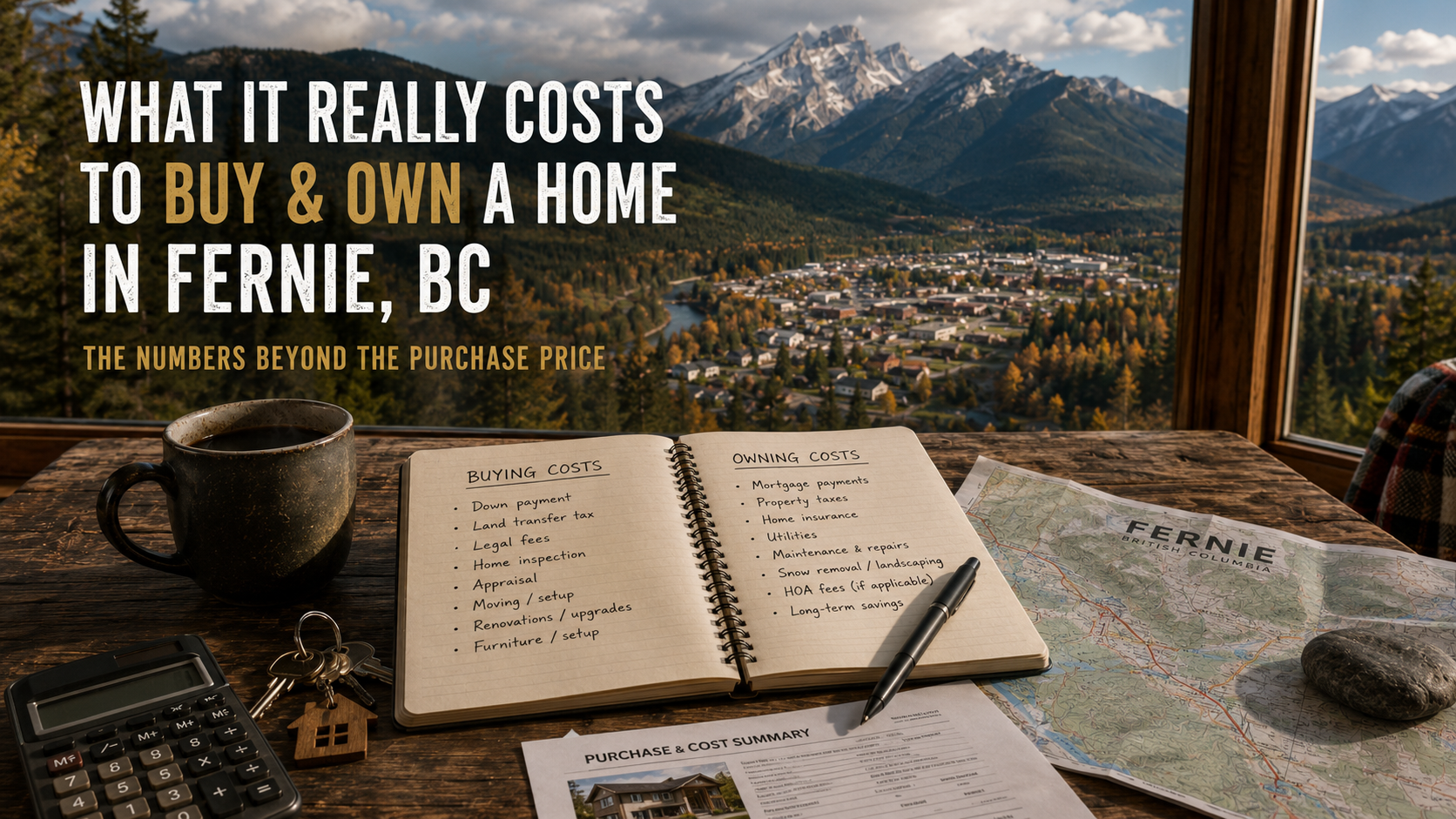
First-time home buyer checklist on a wooden table with a Fernie coffee mug, house keys, mortgage planning documents and mountain scenery, illustrating the steps to buying your first home in Fernie, BC.

The short answer

A first-time buyer in Fernie should start with a fully documented mortgage pre-approval, preserve cash for closing and repairs, and choose a property by total monthly cost rather than price alone. Eligible buyers may combine an FHSA and the federal Home Buyers’ Plan and may receive a BC property-transfer-tax exemption, but each program has separate conditions and price limits.

Fernie is challenging for first-time buyers because the entry-level market is limited and varied. A lower-priced listing might be a condo with high fees, a manufactured home with financing restrictions, a property needing major work or land that requires an entirely different loan.

The goal is not merely to qualify for a purchase. It is to own the property comfortably after completion.

Build the budget in the right order

Budget item What to include
Purchase funds Down payment, deposit and mortgage amount.
Closing costs Property transfer tax if payable, legal work, inspection, insurance and adjustments.
Monthly carrying cost Mortgage, strata fee, property tax, utilities and insurance.
Immediate reserve Repairs, furnishings, seasonal gear & tools, and moving costs.
Long-term reserve Replacing HVAC equipment, appliances, roof or building levies, etc.

Use a mortgage pre-approval that matches Fernie property types

Tell the lender what you may buy. A conventional detached home, older condo, resort unit, manufactured home, leased-land interest and vacant lot may be underwritten differently. Ask whether the lender has restrictions on building age, size, rentals, strata condition or insurer approval.

Keep your finances stable between pre-approval and completion. New debt, a job change or a large purchase can affect final approval even after an accepted offer.

First-time buyer programs to investigate:

BC Property Transfer Tax Exemption

BC’s current first-time home buyers’ program can reduce or eliminate property transfer tax for eligible buyers. For qualifying registrations, the published full-exemption threshold is a fair market value of $835,000 or less, with the exemption applying to the first $500,000. Residency, prior ownership, property size and principal-residence conditions apply.

First Home Savings Account

The FHSA allows an eligible first-time buyer to save toward a qualifying first home. CRA states that first-year participation room is $8,000 and contributions are generally deductible. Open the account early enough to create room and get personal tax advice.

Home Buyers’ Plan

CRA’s Home Buyers’ Plan currently allows up to $60,000 to be withdrawn from RRSPs, subject to its conditions. An eligible buyer may use the HBP and a qualifying FHSA withdrawal for the same home. RRSP withdrawals under the HBP create a repayment obligation.

What entry-level ownership looks like in Fernie

At the lower end of Fernie’s market, buyers often compare small condos, older townhomes, manufactured homes and properties needing work. Compare the full package: financing, monthly fees, land ownership, building condition, renovation ability, storage, parking and resale audience.

A one-bedroom condo with low overheads may work better than a larger property that strains the budget. Conversely, a low list price can be misleading if fees, insurance or planned work are high.

Make a protected offer

Conditions should match the property. Common subjects include financing, inspection, insurance, title and property disclosure review. For a strata, add document review. For rural property, well, septic and water questions may apply. The wording and timing should be considered with your real estate and legal professionals.

Your first 90 days of ownership

  • Change locks and confirm insurance is active at completion.
  • Learn shutoffs, heating systems, sump pumps and snow-storage areas.
  • Create a maintenance calendar before winter.
  • Keep receipts and permits for improvements.
  • Do not drain the emergency reserve on cosmetic upgrades.

Frequently asked questions

How much down payment do I need in Fernie?

It depends on price, property type, lender and mortgage-insurance rules. Ask a Canadian mortgage professional for a property-specific calculation and keep separate funds for closing and repairs.

Can I use both an FHSA and the Home Buyers’ Plan?

CRA states that eligible buyers can make qualifying withdrawals from both for the same qualifying home, provided all conditions are met.

Do first-time buyers pay BC property transfer tax?

Eligible buyers may receive a full or partial exemption. Qualification depends on the buyer, fair market value, property size, residential use and occupancy requirements.

Should I buy a condo or wait for a house?

Choose the option that works at a sustainable total cost and for at least the next several years. Waiting is not automatically safer, and buying a compromised property simply to enter the market is not automatically better.

The bottom line

The best Fernie real estate decisions are made property by property. Rules, documents, condition and location matter more than a broad label or an optimistic online estimate.

If you want a clear, local assessment before you buy or sell, call or text me at 778-745-0347 or email phil@philgadd.com. I will help you identify the questions that matter before they become expensive.

Phil Gadd is the owner of First Tracks Real Estate Group, operating under eXp Realty in Fernie, BC. Phil has lived in Fernie for 17 years and has sold real estate in the Elk Valley for eight years, helping buyers and sellers across Fernie, Sparwood, Jaffray and Lake Koocanusa.

Posted in Buying a Home
Oct. 14, 2026

Selling a Home in Fernie: How to Prepare, Price and Launch It

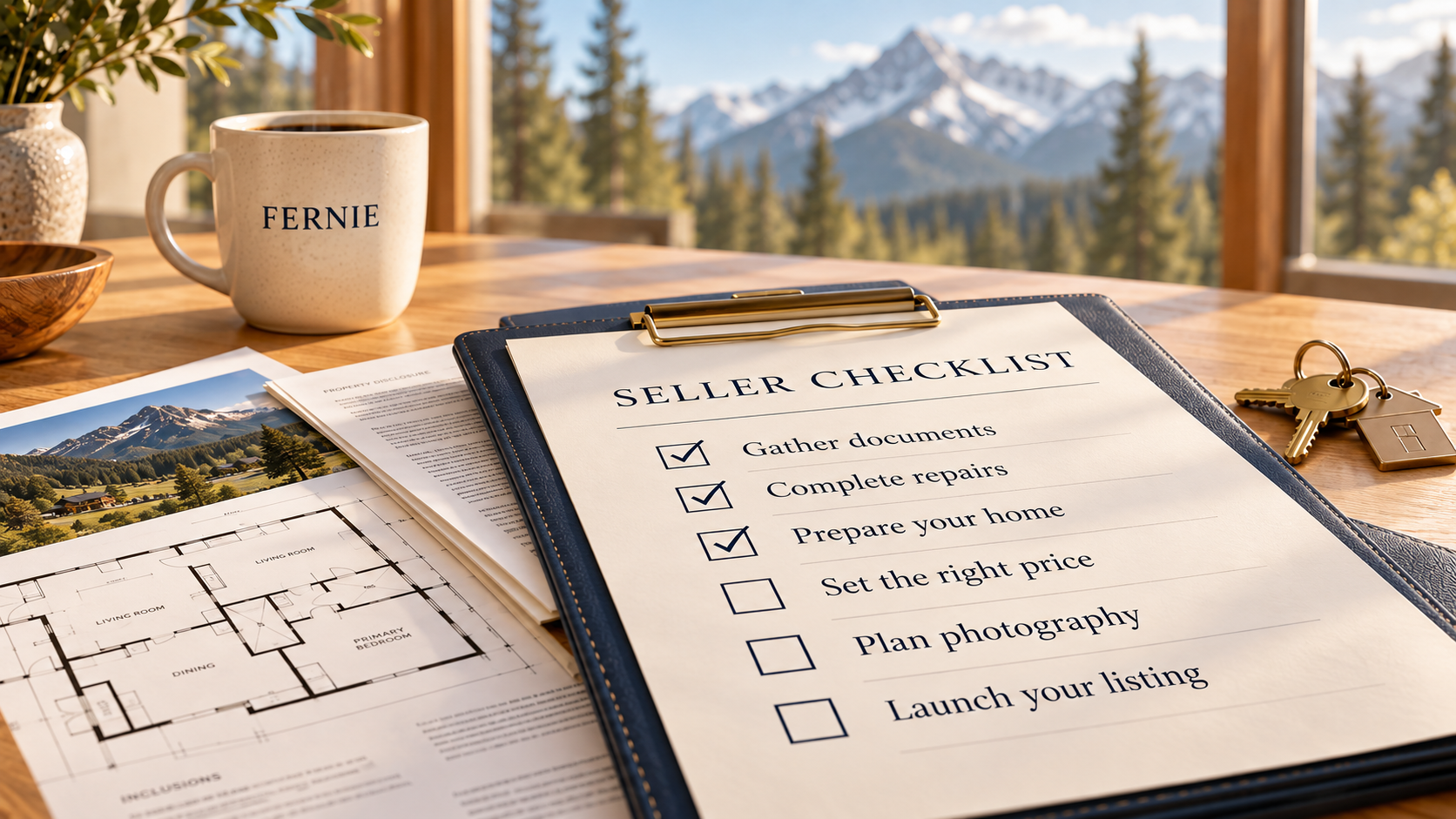
Seller checklist on a clipboard beside floor plans and house keys with Fernie mountains in the windowThe short answer

The strongest Fernie sale starts before the listing goes live: resolve permit and disclosure questions, address obvious issues or maintenance concerns, prepare documents, price against the correct market segment and launch with complete photography and a clear property story. The first weeks matter, and accuracy matters more than manufactured urgency.

Fernie buyers are not only comparing bedrooms and square footage. They are comparing location, existing systems, storage, potential issues, renovation quality, rental legality, strata health, views and proximity to amenities. Good preparation makes those advantages easy to verify.

The six-stage Fernie selling plan

Stage Seller priority
1. Diagnose Identify the likely buyer and the property’s real competition.
2. Document Gather permits, invoices, disclosure, strata or rental records.
3. Repair Fix confidence-killing defects and complete unfinished work.
4. Present Clean, simplify, stage and photograph for the season.
5. Price Use relevant sold and competing evidence, not a town-wide square foot average.
6. Launch Coordinate access, marketing, responses and offer review.

Prepare the paperwork before the photos

Buyers lose confidence when basic answers arrive late. Gather property-tax information, utility costs, renovation permits, warranties, surveys, leases, rental records and invoices for major work. Strata sellers should order current documents early. Resort or income-property sellers should assemble management agreements and GST information for professional review.

Disclose known material latent defects

BCFSA explains that sellers have a common-law duty to disclose latent defects that cannot be found through reasonable inspection and make the property dangerous, unfit for habitation or unfit for a known intended purpose. Licensees have broader disclosure duties, including certain defects involving great expense, local-authority notices and missing appropriate permits.

A Property Disclosure Statement is a common way to provide information, but it is not a substitute for legal advice. Be accurate and update information if conditions change. Concealment is not a marketing strategy.

Repairs that protect buyer confidence

In Fernie, small signs of water or winter neglect can make buyers fear a much larger problem. Prioritize active leaks, drainage, damaged roofs or flashing, heating reliability, unsafe stairs or decks, broken windows and unfinished permitted work. Keep invoices and reports.

Cosmetic work should support the property rather than disguise it. Fresh paint, lighting and decluttering can help, but sensible buyers will still ask about the roof, foundation, mechanical systems and snow management.

Price within the right market segment

A downtown heritage home, Ridgemont condo, Montane townhome and ski-hill unit are not interchangeable. Use recent relevant sales, current competitors, condition and buyer demand. In a small market, one unique sale can distort the average.

The list price should create a credible path to market value. Starting too high can reduce early attention and leave the property competing against newer listings after price reductions.

Market the Fernie-specific value

  • Show parking, garages, ski and bike storage clearly.
  • Explain legal suites or rental permissions with evidence.
  • Photograph views accurately and identify orientation.
  • Show winter access, driveway grade and snow storage.
  • Describe trail, downtown and resort access without exaggerating.
  • Include floor plans and practical room dimensions where available.

Compare offers beyond price

When you receive an offer, review deposit, financing, inspection, document conditions, dates, included items and the buyer’s ability to complete. A slightly higher offer with unresolved financing or unsuitable dates may not be the strongest offer. Your real estate professional should explain the risks and let you choose.

Frequently asked questions

When is the best time to sell in Fernie?

There is no universal answer. Spring and summer can show yards and access well, while ski-season buyers may be highly motivated. Inventory, property type and your readiness often matter more than the calendar.

Should I renovate before selling?

Complete repairs that reduce uncertainty first. A major renovation should be supported by likely market return, permits, contractor availability and your timing.

Do I have to complete a Property Disclosure Statement?

BCFSA describes it as a common voluntary disclosure form, while known material latent defects must always be disclosed. Get advice on your specific obligations.

How long does it take to sell a Fernie home?

It varies by price, property type, condition, season and competition. A realistic pricing and launch plan is more useful than a town-wide average days-on-market figure.

The bottom line

The best Fernie real estate decisions are made property by property. Rules, documents, condition and location matter more than a broad label or an optimistic online estimate.

If you want a clear, local assessment before you buy or sell, call or text me at 778-745-0347 or email phil@philgadd.com. I will help you identify the questions that matter before they become expensive.

Phil Gadd is the owner of First Tracks Real Estate Group, operating under eXp Realty in Fernie, BC. Phil has lived in Fernie for 17 years and has sold real estate in the Elk Valley for eight years, helping buyers and sellers across Fernie, Sparwood, Jaffray and Lake Koocanusa.

Posted in Selling Your Home
Oct. 7, 2026

Fernie Real Estate Market Update: September 2026 - Did Prices Really Drop 26%?

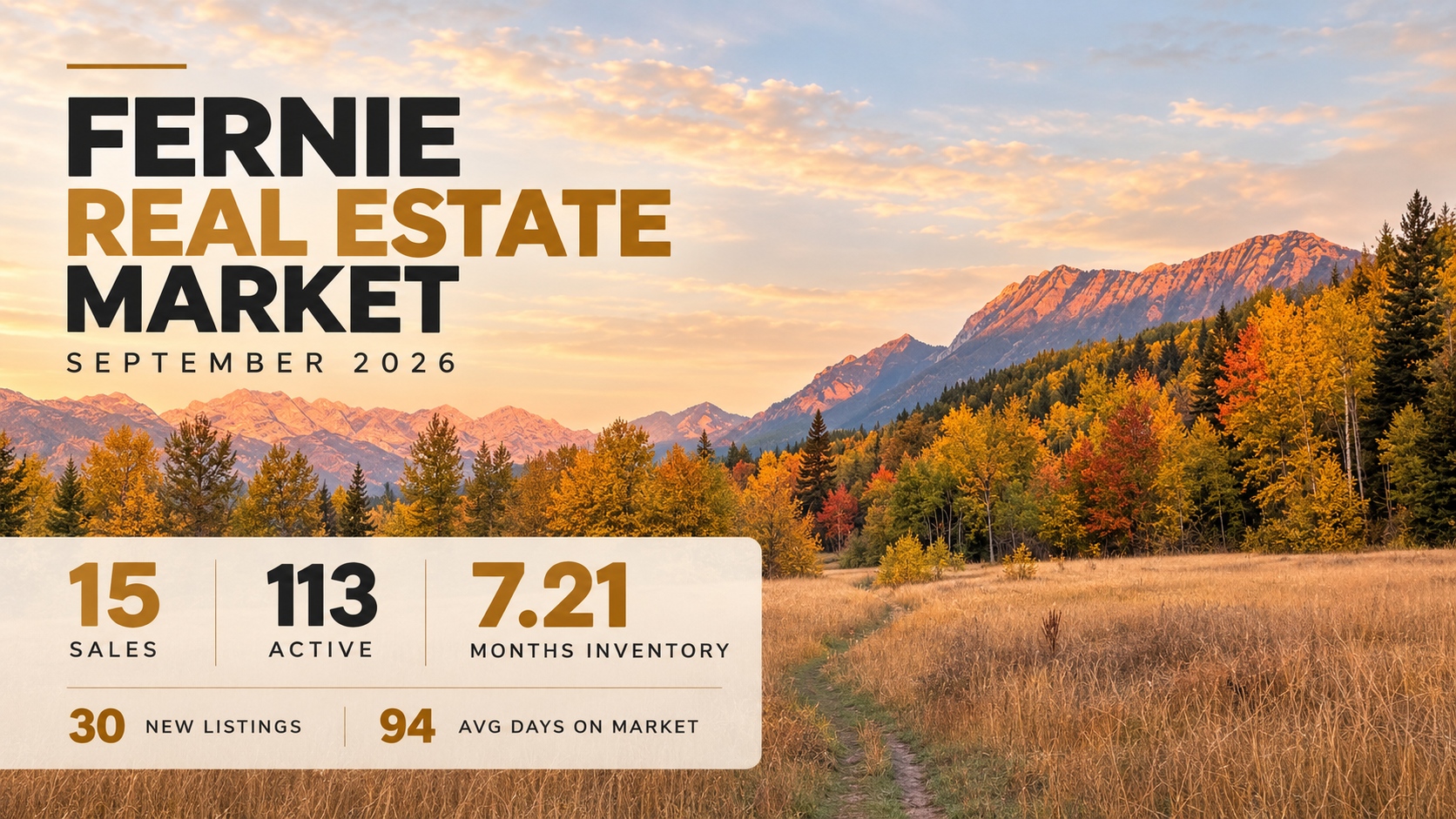
Autumn view of Fernie, BC with September 2026 real estate market statistics showing 15 sales, 113 active listings and 7.21 months of inventory.

The short answer

Fernie’s reported average sale price was $660,530 in September 2026, down 26% from September 2025. That does not mean every home in Fernie lost a quarter of its value. The average reflects the properties that sold, and a change in that mix can move the number sharply.

What I am seeing locally is stronger activity below $1 million and a more selective market above that level. Meanwhile, active inventory was down 13.08% year over year, even as average days on market reached 94.4. Buyers and sellers need to look at their particular property type and price range before drawing conclusions from the headline.

Fernie real estate market at a glance

Market measure September 2026 Comparison or context
Average sale price $660,530 Down 26.00% year over year
Average list price $691,180 Down 24.69% year over year
Active inventory 113 properties 130 in September 2025; down 13.08%
Months of inventory 7.21 months Overall supply relative to the sales pace
Average sale-to-list ratio 94.22% An average across the reported sales
Average days on market 94.4 days 50.29 days in September 2025

Source: September figures in the supplied Fernie Market Decoded presentation and accompanying market-report commentary. Figures describe the report’s market sample, not the value or expected selling time of an individual home.

Why did the average sale price fall 26%?

An average sale price is the total value of the sales divided by the number of properties sold. It changes when prices change, when the mix of properties changes, or when both happen together.

In a small market like Fernie, a few higher-priced sales can make a substantial difference. A month with several luxury transactions can produce a much higher average than a month dominated by condos and more affordable homes.

For a simple illustration, one $500,000 sale and one $2 million sale produce a $1.25 million average. Two $500,000 sales produce a $500,000 average. That calculation tells us what sold; it does not show that the same properties lost value. These are illustrative figures, not September transactions.

My reading of September is that stronger activity at lower price points, combined with fewer high-end transactions, is an important part of the explanation. The headline alone cannot tell us how much of the change came from the mix and how much came from changes in comparable property values.

That distinction matters if you are pricing your home or deciding what to offer. A broad average is useful background. Recent sales of genuinely comparable properties are much more useful for the decision in front of you.

What is happening below and above $1 million?

In my current work with Fernie buyers and sellers, I am seeing well-priced properties below $1 million move steadily, with some attracting multiple offers or selling above asking. Above $1 million, and particularly further into the higher end, the pace is more selective.

Price range My local observation Practical implication
Below $1 million Stronger activity; some competitive sales Have financing and a viewing plan ready.
$1 million and above Slower pace and more selective buyers Compare closely on price, condition and presentation.

The $1 million line is a useful shorthand, not a rule. A property below it can still sit if the price or condition is wrong. A well-positioned higher-end home can still find its buyer.

Fernie also has very different ownership decisions within the same price bracket. A ski-hill condo and an in-town family home may compete for different buyers and carry different ongoing costs. Before treating either as a bargain, compare the total ownership costs and the property’s suitability for your intended use.

Is Fernie inventory getting tighter?

Compared with September last year, yes. The report shows 113 active properties, down from 130. That is 17 fewer listings, or a 13.08% decline.

Lower inventory means fewer listings overall. It does not, by itself, prove that demand has increased or that every part of the market favours sellers. The properties available may also be a poor match for what buyers actually want.

If your search requires a particular neighbourhood, a garage and a specific property type, the useful choice can be much smaller than the town-wide total suggests. This is why a buyer can read about longer selling times and still face competition for the home that fits.

What does 7.21 months of inventory mean?

Months of inventory estimates how long the available supply would last at the sales pace used in the calculation, assuming no new listings arrived. September’s reported figure was 7.21 months.

It is a measure of supply relative to sales, not a forecast that your home will take seven months to sell. Higher months of inventory generally means more supply relative to demand; lower months generally means less.

I would not use 7.21 months alone to label all of Fernie a seller’s market. The useful next step is to compare supply and recent sales within the price range and property type that matter to you. The market-wide figure can hide a competitive segment alongside a much slower one.

Are Fernie properties selling below asking price?

The September presentation reports an average sale-to-list ratio of 94.22%, rounded to about 94% in the video. That suggests negotiation was part of many successful sales, but it is not a standard discount available on every listing.

A sale-to-list ratio compares a sale price with a listing price. The source’s choice of original or final list price matters, because a ratio based on the final price will not capture earlier reductions. An average across individual sale-to-list ratios also need not equal the average sale price divided by the average list price.

For buyers, the right offer comes from comparable sales, the property’s condition and the competition. For sellers, the average is not a reason to add an automatic negotiation buffer to the asking price. Starting too high can make it harder to attract the right buyers in the first place.

How long are Fernie properties taking to sell?

The reported average was 94.4 days on market, compared with 50.29 days in September 2025. That points to a slower average pace among the sales represented in the report.

Days on market measures the listing’s market exposure under the report’s rules. It does not mean each buyer spent 94 days deciding, and it does not measure the time between an accepted offer and possession.

A few long-running listings can lift the average in a small market. Some well-priced homes can still sell quickly while others take considerably longer. Your likely selling time needs a closer look at the competing listings and recent sales in your own segment.

What should Fernie sellers do heading into Q4?

Price against the properties buyers will compare

Start with recent comparable sales and the active competition. Above $1 million, give particular attention to what makes your home worth the difference from the alternatives. A price that worked during the rapid-growth years may not be supported today.

Make the property easy to assess

Clear photography, accurate floor plans, good presentation and straightforward access help buyers understand the home. Have the relevant property documents ready and address obvious maintenance questions. Marketing supports a sensible price; it cannot guarantee a sale at an unsupported one.

Plan for negotiation without assuming a fixed discount

Decide which terms matter as well as price, including timing and included items. Review showing feedback and new competing listings as they appear. A patient approach still needs an agreed point at which to reassess the strategy.

What should Fernie buyers do heading into Q4?

Build your shortlist around the right Fernie segment

Separate in-town homes, resort properties and other ownership options before comparing prices. If you are shopping below $1 million, focus on the recent sales and current listings that meet your needs. The performance of a much more expensive property is unlikely to explain the competition you face.

Prepare before the right listing appears

Have your financing conversation early, understand your comfortable ownership budget and be ready to arrange a viewing. The combination of lower inventory and competitive individual listings means a slower overall market does not always give you extra time.

Keep due diligence part of the plan

Use the opportunity to understand the property, its condition and any strata or use restrictions. A longer listing history can be a reason to ask better questions, but it is not proof of a problem or a guaranteed discount. Let the evidence guide both your offer and your conditions.

What does the longer-term picture tell us?

My impression is that Fernie has moved into a more price-sensitive period after the rapid increases of the pandemic years. That is an observation about the market I am working in, not a promise that every property has reached a permanent plateau.

For context, the August report put the January-to-August 2026 average sale price at $832,187, compared with $837,398 for the equivalent period in 2025, a decline of 0.62%. Those are earlier year-to-date figures, not September results. They illustrate why the reporting period matters.

A monthly average, an annual average and a median each answer a different question. None can tell you what a specific home bought ten years ago is worth today without examining the property and relevant comparable sales.

Frequently asked questions

Did Fernie home values fall 26% in September 2026?

The reported average sale price fell 26% year over year. That is not evidence that every Fernie home lost 26% of its value. The mix of properties sold affects the average, so comparable sales are needed to assess an individual home.

What was the average sale price in September 2026?

The September market presentation reports an average sale price of $660,530. This is an average for the reported sales, not a benchmark valuation for a typical detached home.

How many properties were available in Fernie?

The report shows 113 active properties, compared with 130 in September 2025. That is a year-over-year reduction of 13.08%.

Is Fernie a buyer’s market or a seller’s market?

The answer depends on the segment. The overall 7.21 months of inventory should be considered alongside relevant sales and competing listings. My local experience is of stronger activity below $1 million and greater selectivity at higher prices.

Can I expect to buy at 94% of asking price?

No. The reported 94.22% sale-to-list ratio is an average, not an entitlement to a discount. Some properties sell closer to asking or above it, while others require more negotiation.

Should I wait until spring to buy or sell?

Base that decision on your needs, finances and the relevant properties available now. September’s overall average does not establish that spring will bring a better price or more suitable choice for your particular situation.

The bottom line

September’s lower average sale price deserves context. The report also shows fewer active listings than a year earlier, longer average days on market and negotiation on successful sales. These conditions can coexist, especially when different property types and price ranges attract different buyers.

For your next move in Fernie, narrow the evidence to the homes you would actually buy or the properties your home would compete against. That is where a useful pricing or offer strategy begins.

If you want to understand what the September numbers mean for your home or your search, call or text me at 778-745-0347 or email phil@philgadd.com. I am happy to work through the relevant listings and recent sales with you.

Phil Gadd, Personal Real Estate Corporation, is a REALTOR® and team lead of First Tracks Real Estate Group, brokered by eXp Realty. Phil has lived in Fernie for 17 years and sold real estate in the Elk Valley for eight years.

Related Fernie market guides

August 2026 Fernie real estate market update

Fernie market data and what the numbers mean

Where to live in Fernie BC

Sources and methodology

Reviewed October 3, 2026. September figures come from Phil Gadd’s supplied Fernie Market Decoded presentation, pages 2, 5 and 6, and his September 2026 market-report commentary. Observations about activity by price range reflect Phil’s local experience. They are not a published statistical breakdown of September sales by segment.

Average sale price, average list price, inventory, months of supply, sale-to-list ratio and days on market describe different aspects of the sample. They should not be treated as estimates of an individual property’s value or guaranteed outcome. The mix of properties sold and the period measured can materially change averages.

The earlier year-to-date comparison is from the published August report. Its period ends in August and has not been relabelled as a September result. Public reference pages checked October 3, 2026:

August report and methodology

Association of Interior REALTORS® market statistics

Posted in Market Updates
Sept. 30, 2026

Can You Airbnb a Property in Fernie? A 2026 Short-Term Rental Guide

House keys, a rental booking calendar and a five-part buyer checklist sit beside a “Fernie, BC” coffee mug, with a mountain backdrop. The image illustrates the provincial rules, zoning, strata bylaws, title restrictions and financing checks buyers should investigate before purchasing a short-term rental in Fernie, British Columbia.

The short answer

You can operate a short-term rental in Fernie only when the specific property complies with every applicable layer: provincial rules, City zoning and business licensing, strata bylaws if applicable, and any title, financing, insurance or management restrictions. A previous rental history, online listing or seller statement does not by itself prove that future short-term rental use is legal.

This is one of the most common, and potentially most expensive, assumption I see in Fernie real estate. Buyers find a unit that has been short-term rented and conclude they can continue. The correct answer depends on the location, ownership structure and intended operation.

The five-rule test

Layer Question to verify
Province of BC Does the principal-residence requirement apply, and is the host registered where required?
City of Fernie or RDEK Does zoning permit the use and can the owner obtain the required STR business licence?
Strata (if applicable) Do current bylaws permit the intended rental and guest use?
Title and contracts Are there covenants, owner-use limits or rental-management obligations?
Lender, insurer and tax Will financing and insurance cover the use, and what GST/income-tax advice is required?

Provincial principal-residence rules

BC’s Short-Term Rental Accommodations Act introduced a provincial principal-residence requirement in many communities. The Province’s current page specifically includes Fernie and explains that exemptions may apply to certain accommodation types. Eligibility can depend on how the property was designed, zoned and restricted, not simply whether it sits near the ski hill.

A buyer should check the current provincial page and registration requirements before making an offer. Rules and exemptions can change, and an owner’s personal eligibility may not transfer with the property.

City zoning and business licensing

The City of Fernie requires residents operating a short-term rental to hold a Short-Term Rental Business Licence. For properties not zoned Condo/Hotel, the City’s application requirements include identification showing the same address. Condo/Hotel-zoned properties have a different identification provision.

The application also calls for supporting material such as a title or tax certificate, site and floor plans, a self-inspection checklist, parking information and a contact who can respond to City requests. A listing description saying “Airbnb allowed” is not a substitute for confirmation from the City.

Strata permission is separate

Even where provincial and municipal rules permit the use, a strata can have bylaws affecting rentals, occupancy, noise and guest behaviour. Review the registered bylaws, rules, minutes and any fines or enforcement history. Ask whether the building’s insurance anticipates nightly rental activity.

The income calculation buyers should use

Gross nightly revenue is not cash flow. Build a conservative annual estimate after management, platform fees, cleaning gaps, utilities, strata fees, insurance, property tax, repairs, supplies, licence costs, financing and tax. Include lower shoulder-season occupancy and keep a reserve for a major building levy.

If the deal only works with optimistic occupancy and no maintenance, it does not work yet.

A practical condition checklist

  • Written zoning confirmation for the exact parcel and unit.
  • Current City / RDEK licensing requirements and evidence the proposed operation can qualify.
  • Provincial principal-residence and registration analysis.
  • Strata bylaws, minutes, insurance and rental enforcement history.
  • Review of title, disclosure statement and any rental-management agreement.
  • Written lender and insurer approval for the intended use.
  • Accountant advice on GST, income tax and change-of-use consequences.

Frequently asked questions

Is every condo at Fernie Alpine Resort exempt from the principal-residence rule?

No. Do not infer an exemption from location alone. Check the Province’s current exemption criteria and the property’s zoning, use restrictions and records.

If a property already has an Airbnb listing, can I keep it?

Not automatically. Accounts, registrations and licences may not transfer, and the buyer must independently qualify under all current rules.

Can I short-term rent my secondary suite?

The City’s zoning definition and licensing rules must be checked carefully; the published zoning definition excludes secondary suites and secondary dwelling units from the short-term-rental definition. Confirm the current bylaw with City staff.

Is a legal short-term rental guaranteed to be profitable?

No. Legality and profitability are separate questions. Use verified historical income where available and model all expenses, seasonality and owner-use time.

The bottom line

The best Fernie real estate decisions are made property by property. I can help you do your homework and make sure you make a decision that works for you.

If you want a clear, local assessment before you buy or sell, call or text me at 778-745-0347 or email phil@philgadd.com. I will help you identify the questions that matter before they become expensive.

Phil Gadd is the owner of First Tracks Real Estate Group, operating under eXp Realty in Fernie, BC. Phil has lived in Fernie for 17 years and has sold real estate in the Elk Valley for eight years, helping buyers and sellers across Fernie, Sparwood, Jaffray and Lake Koocanusa.

Posted in Real Estate News
Sept. 23, 2026

Fernie vs Kimberley vs Invermere vs Canmore: Which Mountain Town Should You Choose?

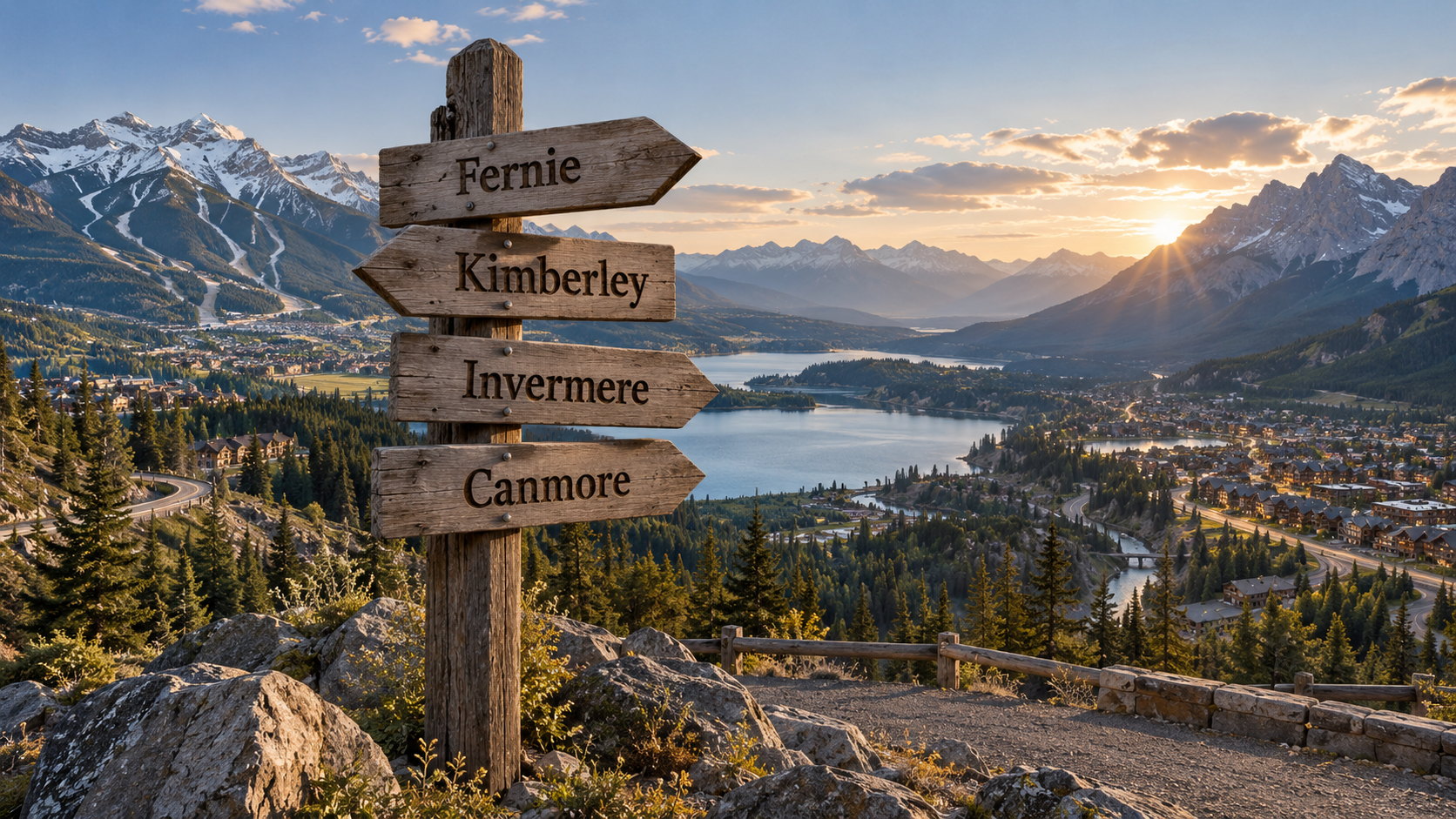
A rustic wooden signpost points toward Fernie, Kimberley, Invermere and Canmore against a dramatic mountain valley at golden hour. The image represents a real estate and lifestyle comparison between four popular mountain towns within reach of Calgary, highlighting the trade-offs between skiing, lake access, amenities, travel time and property value.

The short answer

People compare these four towns because each offers a different version of mountain-town life within reach of Calgary.

Choose Fernie if downhill skiing, trails and a small working mountain town are the priority. Kimberley generally offers a lower-cost entry and easier access to Cranbrook Airport. Invermere is strongest for a lake-and-golf lifestyle with the Panorama ski area nearby. Canmore offers the easiest Calgary access and most amenities, but generally at the highest property cost.

The right choice depends on which part of that life you intend to use every week. A buyer focused on powder mornings should not use the same scorecard as someone who wants summer lake access, frequent flights or a low-maintenance retirement base.

I live and sell real estate in Fernie, so that is the market I know most deeply. I won't pretend to be the local expert in every other community. This comparison uses public information and the questions I hear from buyers who are genuinely deciding between them. Before purchasing elsewhere, work with a good local agent in that market.

The comparison at a glance

Factor Fernie Kimberley Invermere / Panorama Canmore
Calgary access About three hours in normal conditions Longer drive, often around four hours depending on route and conditions 294 km from Calgary airport to Invermere 106 km west of Calgary, with the quickest access
Main winter draw Fernie Alpine Resort is just 5 km from town Alpine Resort and Nordic network about 3 km from town Panorama Mountain Resort about 20 km from Invermere Multiple Bow Valley ski areas, generally requiring a drive
Main summer draw Biking, hiking, Elk River and trail access Biking, golf, hiking and a quieter summer rhythm Lake Windermere, boating, beaches and golf Hiking, biking, climbing and national-park access
Relative property cost Premium Kootenay ski market Generally lower entry than Fernie or Canmore Broad mix, with premiums for lake and resort property Usually the highest-cost market of the four
Airport access About one hour to Cranbrook airport; Calgary used for more routes Less than 30 minutes from Cranbrook airport in normal conditions About 142 km to Cranbrook airport Calgary International is the major airport
Community scale Small, year-round working town Small mountain community connected closely to Cranbrook Regional service and recreational hub Larger, busier and more urban in feel
Best fit Buyers who want skiing and trails embedded in daily life Buyers prioritizing value, golf and airport access Buyers prioritizing lakes and summer recreation Buyers prioritizing Calgary access and city amenities
Main compromise Distance from a major airport and higher prices than nearby Kootenay towns Smaller ski market and longer Calgary drive Skiing is outside town and the area is more summer-weighted High purchase cost, tourism pressure and stricter land constraints

Drive times are approximate and can change significantly in winter. Always test the route you expect to use.

Fernie: the ski town that is still a working town

Fernie’s defining advantage is how close the mountain is to ordinary life. Fernie Alpine Resort is roughly ten minutes from downtown, and the town is surrounded by biking, hiking and Nordic networks.

Fernie is a proper community town with an historic main street, schools, hospital, recreation facilities and an economy supported by mining, construction, healthcare, education, tourism, trades and remote work. It is not simply a collection of vacation condos attached to a resort.

For a skier or rider, this makes the lifestyle piece easy. A powder morning does not require a day trip. For a mountain biker or trail runner, several trail systems connect directly to residential areas.

The trade-offs are price and access. Fernie has become a premium Kootenay market. It is approximately three hours from Calgary and about one hour from Canadian Rockies International Airport near Cranbrook, but beware winter road conditions.

Fernie is strongest for buyers who want the mountain and outdoor community to shape the week, not only occasional holidays.

Kimberley: lower entry, golf and easier regional-airport access

Kimberley is frequently the value alternative in this group. Buyers can often find detached homes and condos at prices below comparable Fernie or Canmore property, although the best resort and newer homes still command premiums.

Kimberley Alpine Resort sits close to the community, and the area has a strong Nordic, biking and golf identity. It also has a meaningful access advantage for people using Canadian Rockies International Airport, which is less than 30 minutes away in normal conditions.

Kimberley feels closely connected to Cranbrook for larger retail, medical services and employment. That can be an advantage if you want small-town living without relying on the town for every service.

The main question is whether the recreation profile is right. Fernie’s downhill terrain and snow reputation are major reasons serious skiers pay more to be there. Kimberley can offer a more relaxed and affordable mountain base, but it is not trying to duplicate Fernie’s ski experience.

Kimberley is strongest for a buyer who values a smaller community, regional-airport access and a more approachable purchase price.

Invermere and Panorama: build the decision around summer

Invermere is the clearest choice if the lake is as important as the mountain, or more important.

Lake Windermere shapes the area’s summer identity. Boating, swimming, beaches and golf attract buyers from Calgary and across Western Canada. Panorama Mountain Resort provides serious downhill skiing roughly 20 kilometres outside Invermere.

The property market is broad. It includes in-town homes, condos, resort property, lake-oriented communities, acreages and nearby recreational developments. Two properties described as “Invermere area” can deliver completely different access to water, services and winter recreation.

The trade-off for skiers is that the resort is not at the edge of downtown. The lifestyle is more regional and vehicle-dependent. For many owners, however, the balance of summer lake use, golf and winter skiing is exactly the point.

Invermere is strongest for buyers who want the boat and beach, with a credible ski mountain nearby.

Canmore: access and amenities, at a price

Canmore is in a different category of access. Tourism Canmore places the town 106 kilometres west of Calgary, and its population is approximately 17,000. It offers more restaurants, services, recreation infrastructure and transportation options than the smaller BC communities in this comparison.

It is also beside Banff National Park and within reach of several major ski areas. The skiing is excellent, but it involves planning a day trip and driving out to Sunshine or Lake Louise, rather than being at the lift in ten minutes.

The cost is the obvious issue. Canmore’s proximity to Calgary and Banff, constrained land base and international profile place heavy pressure on property values. Buyers also need to understand tourist-home designations, short-term-rental rules and the difference between residential and visitor-accommodation property.

Canmore is strongest for someone who expects to travel to Calgary frequently, wants more amenities and can comfortably absorb the higher acquisition cost.

Which town gives you the most property for the money?

As a broad rule, Kimberley usually offers the lowest entry point of the four. Invermere provides wide variation depending on lake and resort proximity. Fernie carries a premium because of its ski access and limited inventory. Canmore is usually the most expensive.

That does not mean the lowest purchase price is the best value.

A Fernie property may be worth more to someone who skis 50 days a year because they will actually use the location. An Invermere home may offer far more value to a household that boats every weekend. Canmore’s cost can be justified for someone who needs Calgary access twice a week. Kimberley may deliver the best balance for a buyer who wants a detached home and does not need Fernie’s terrain.

Value is use divided by total cost, not simply the lowest listing price.

How access changes ownership

Frequent air travel

Canmore is the easiest choice for Calgary International Airport. Kimberley has the strongest proximity to Cranbrook’s airport. Fernie is also within reach of Cranbrook, but farther away. Invermere is approximately 142 kilometres from Cranbrook airport and 294 kilometres from Calgary airport.

Weekend driving from Calgary

Canmore is the clear winner. Fernie and Invermere are realistic weekend drives for many owners, but winter conditions and holiday traffic should be part of the decision. Kimberley is farther and generally asks more commitment for a short weekend.

Living full time

Access should be judged differently. If you travel only occasionally, property fit and community may matter much more than saving an hour on airport travel.

Which town works best by buyer profile?

The committed downhill skier or rider

Fernie is usually the strongest fit if terrain, snow and having the resort beside town are the main priorities.

The lake-and-golf household

Invermere has the clearest advantage because Lake Windermere and the Columbia Valley’s golf offering drive the summer lifestyle.

The Calgary professional who needs regular city access

Canmore is difficult to beat for logistics, provided the budget supports the market.

The buyer seeking a lower-cost mountain home

Kimberley deserves serious attention. The purchase budget may reach further while still providing skiing, golf, trails and a genuine small community.

The short-term-rental investor

There is no universal winner. The correct comparison is property-specific net income after zoning, strata, management, licensing, financing, tax and owner-use restrictions. Never compare gross nightly rates without comparing rules and costs.

The permanent relocator

Employment, healthcare, schools, community and daily services become more important than vacation appeal. Spend ordinary time in each town, not only a holiday weekend.

Five questions that usually settle the decision

  1. What activity will I genuinely do at least 30 days a year?
  2. How often must I reach Calgary or an airport?
  3. Do I want a year-round home, a vacation base or an income property?
  4. Would I rather have more property or a better location?
  5. Which compromise will annoy me after five years: price, driving, smaller amenities or weaker access to my preferred recreation?

If you answer those honestly, the shortlist normally becomes much clearer.

Frequently asked questions

Is Fernie cheaper than Canmore?

Fernie is generally less expensive than Canmore for comparable mountain property, although premium Fernie homes and ski-access property can still exceed $2 million.

Is Kimberley cheaper than Fernie?

Kimberley will often provide a lower entry price, particularly for detached homes and condos. Compare current listings and sold data by property type rather than relying on one town-wide average.

Is Fernie or Invermere better for a vacation home?

Fernie is stronger if skiing and trails are central. Invermere is stronger if lake use, boating and golf drive the decision. Both offer four-season recreation, but their seasonal emphasis is different.

Is Canmore better for short-term rentals?

Not automatically. Canmore has strong demand but strict land-use distinctions and expensive acquisition costs. Fernie also requires property-specific zoning, licensing, provincial and strata review. Compare legal net returns, not tourism popularity.

Which town is easiest to reach from Calgary?

Canmore is the easiest by a wide margin. Fernie and Invermere are approximately three-hour-plus trips depending on route and conditions, while Kimberley is generally farther.

The bottom line

There is no winner for every buyer.

Fernie wins when skiing, trails and authentic small-town life are the priority. Kimberley wins when value and regional-airport access matter more. Invermere wins when summer water use leads the decision. Canmore wins on Calgary access and amenities, if the price is comfortable.

If Fernie is on your shortlist, I am happy to give you an honest assessment of what your budget buys and whether another community may suit you better. Call or text me at 778-745-0347 or email phil@philgadd.com.

Phil Gadd is the owner of First Tracks Real Estate Group, operating under eXp Realty in Fernie, BC. Phil has lived in Fernie for 17 years and has sold real estate in the Elk Valley for eight years.

More useful Fernie comparisons

Sources and update references

Posted in Buying a Home
Sept. 16, 2026

Buying a Condo in Fernie, BC: The Strata Documents That Matter

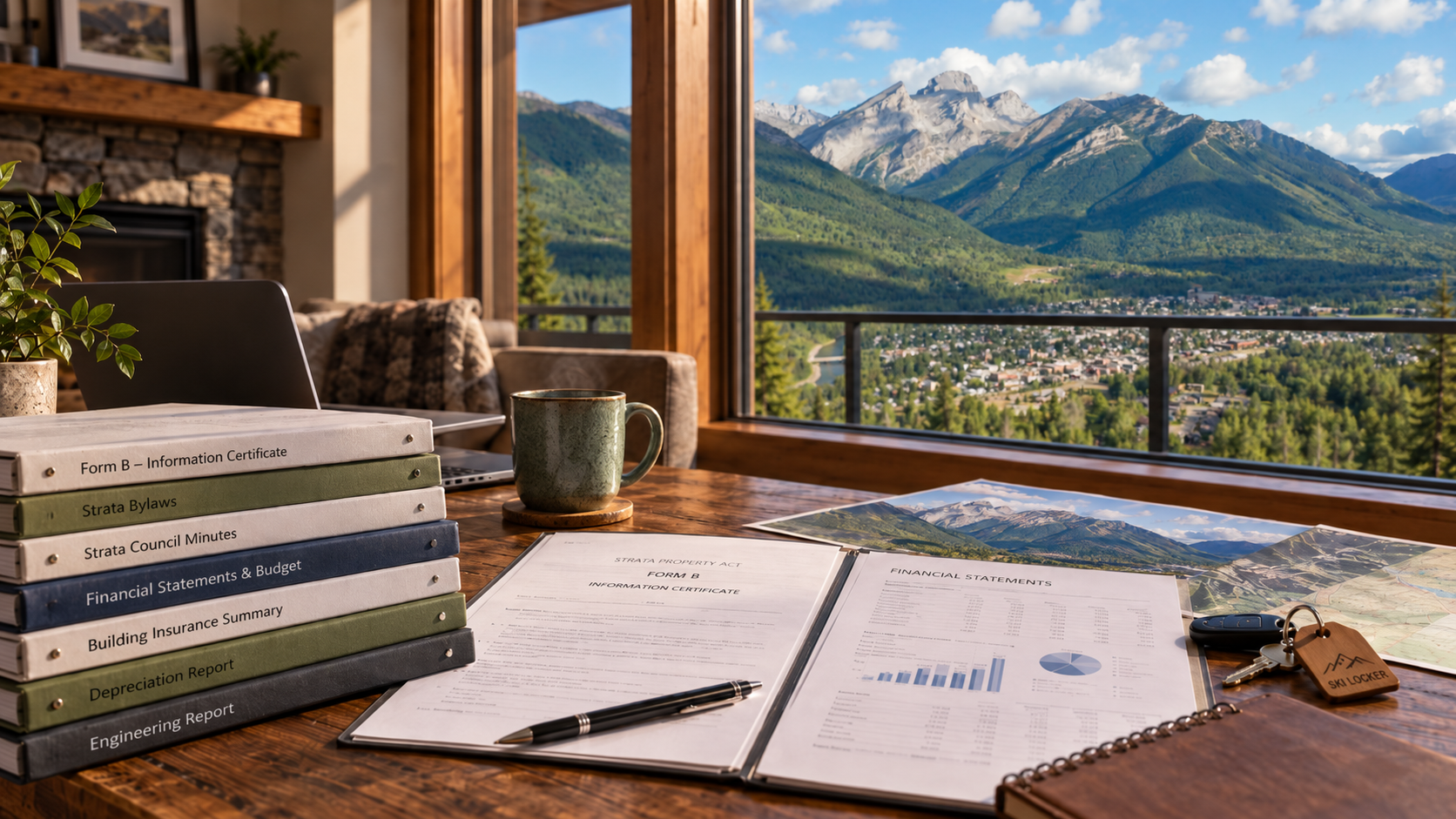
Fernie, BC condo-buying checklist with Form B, strata bylaws, financials, depreciation report, insurance, parking, storage and rental information arranged on a desk overlooking Fernie and the surrounding mountains. The image highlights the key documents, ownership costs and due diligence buyers should review before purchasing a condo in Fernie.

The short answer

Before buying a Fernie condo, review the Form B, bylaws, rules, budget, financial statements, contingency reserve fund, depreciation report, insurance, recent minutes and any engineering reports. Then confirm the exact parking, storage, pet and rental rights attached to the unit. A low monthly fee is not automatically good value if the building is postponing major work.

Fernie’s strata market includes older downtown buildings, purpose-built residential condos, resort properties, townhomes and mixed-use developments. They do not all carry the same risks or operating costs. The document review is building-specific.

A condo can be one of the simplest ways to own in Fernie, but it can also transfer decisions about roofs, windows, water, insurance and snow management from a single owner to a group of owners. That means reviewing the documents is as important as the view.

The documents I want a buyer to read

Document What it can reveal
Form B Fees, money owed, litigation, parking, storage and other unit-specific information.
Minutes Leaks, noise, owner disputes, repairs, quotes and proposed projects not yet reflected in the budget.
Depreciation report Expected timing and cost of major components such as roofs, windows and building systems.
Budget and financials Whether current fees support operations and whether the contingency reserve is growing or shrinking.
Bylaws and rules Usually cover pets, rentals, age restrictions, smoking, renovations, parking and everyday use.
Insurance summary Deductibles, coverage and risks that may affect the owner’s unit policy.

BCFSA explains that a buyer is entitled to obtain a Form B Information Certificate before purchasing. The current budget, rules and most recent depreciation report must be attached. Treat that package as a great starting point, but not the whole investigation.

Read the minutes for patterns, not isolated complaints

One mention of a leak may be routine. Repeated references to water entry, roof patches, frozen pipes or insurer requirements can point to a larger issue. Read at least two years of council and annual-general-meeting minutes when available, then connect recurring topics to the budget and depreciation report.

In a mountain climate, pay particular attention to roofs, decks, drainage, windows, snow storage, heating systems and underground parking. Ask whether repairs are permanent or temporary and whether owners have approved funding.

Strata fee versus total ownership cost

A $450 monthly fee that adequately funds maintenance may be safer than a $250 fee in a building with deferred work. Compare what the fee covers (heat, electricity, hot water, internet, amenities, management, landscaping and snow removal?) before comparing the number.

Also budget for your unit insurance, the strata deductible exposure, property tax, utilities not included in fees and a reserve for special levies. Your insurer should review the strata policy and deductibles before condition removal.

Confirm parking and storage in writing

A ski locker, bike room and secure parking can materially affect Fernie condo value. Do not rely on how the current owner uses them. Confirm whether each space is part of the strata lot, limited common property, common property assigned by rule, or rented separately. Those categories do not provide identical rights.

Rental permission has several layers

Strata bylaws are only one layer. A buyer considering short-term rental use must also check municipal zoning and licensing, provincial requirements, any rental-management agreement, GST history and lender or insurer restrictions. “Rental-friendly” in marketing is not assurance.

Questions to ask before removing conditions

  • What major work is expected in the next five years?
  • Has the building had water, envelope, roof or insurance claims?
  • Are any levies proposed, discussed or recently paid?
  • What exactly do monthly fees include?
  • Are parking and storage rights documented on the Form B or strata plan?
  • Do the bylaws fit my pets, renovations and intended rental use?
  • Can my lender and insurer approve this building and unit?

Frequently asked questions

Are Fernie condos a good investment?

They can be, but value depends on the building, legal use, finances, condition, fees and location. Review verified net carrying cost and resale flexibility rather than assuming every mountain condo will appreciate or rent well.

What is a Form B?

It is a strata information certificate containing unit and corporation information, including fees, money owing, litigation and parking or storage information. Required attachments include the rules, current budget and most recent depreciation report, if obtained.

Can a strata charge a special levy after I buy?

Yes. Owners can approve special levies for expenses that are not covered by the operating fund or contingency reserve. Minutes, reports and budgets help identify risk, but they cannot guarantee that no future levy will occur.

Should I get a home inspection for a condo?

Usually, yes. The inspection scope differs from a detached home, but it can still identify unit issues and visible concerns that should be compared with strata records.

The bottom line

The best Fernie real estate decisions are made property by property. Rules, documents, condition and location matter more than a broad label or an optimistic online estimate.

If you want a clear, local assessment before you buy or sell, call or text me at 778-745-0347 or email phil@philgadd.com. I will help you identify the questions that matter before they become expensive.

Phil Gadd is the owner of First Tracks Real Estate Group, operating under eXp Realty in Fernie, BC. Phil has lived in Fernie for 17 years and has sold real estate in the Elk Valley for eight years, helping buyers and sellers across Fernie, Sparwood, Jaffray and Lake Koocanusa.

Posted in Buying a Home
Sept. 9, 2026

Fernie Real Estate Market Update: August 2026 - Did Prices Really Drop 23%?

The short answer

Fernie’s average sale price dropped 23.08% year over year in August 2026, but that does not mean Fernie property values suddenly fell 23%. Nineteen properties sold during August at an average price of $768,079, compared with $998,523 in August 2025. The important context is the mix of properties that sold. Fernie is a relatively small market, so a few high-end sales can move the monthly average significantly. Zoom out to the year-to-date numbers and the picture is far more stable. The average sale price for 2026 through August was $832,187, just 0.62% below the same period in 2025. At the same time, inventory is lower, new listings were unusually scarce in August and properties that sold still achieved close to 98% of their final asking price. The headline looks dramatic. The underlying market is much more nuanced.

Fernie real estate market at a glance

Market measure August 2025 August 2026 Change
Sold listings 22 19 -13.64%
New listings 28 14 -50.00%
Average sale price $998,523 $768,079 -23.08%
Average list price at closing $1,025,318 $784,004 -23.54%
Sale-to-list ratio 97.18% 97.63% +0.46%
Average days on market 65.82 68.16 +3.55%
Active inventory 114 104 -8.77%
Months supply of inventory 7.39 6.67 -9.75%

Over the previous 12 months, the Fernie market area averaged approximately 16 completed sales per month, with 104 properties remaining active at the end of August.

That is important context because, despite the lower monthly average sale price, buyers actually had less overall inventory available than they did one year earlier.

Why did Fernie’s average sale price fall 23%?

This is where averages can get you into trouble.

Fernie recorded only 19 sales during August. Seven of those sales were below $525,000, another four were between $525,001 and $925,000, and only two were above $1.475 million.

When more of the properties selling are in the lower and middle sections of the market, the average comes down.

Reverse the situation and have several $2 million or $3 million properties close in the same month and the average can jump dramatically.

Neither scenario means every Fernie property changed in value by the same percentage.

This is one reason I tell buyers and sellers not to make decisions from a single town-wide number.

A condo, downtown character home, newer family home, ski-hill property and $2 million luxury residence can all be classified as Fernie real estate while competing for completely different buyers.

The year-to-date price tells a different story

August’s average sale price was $768,079.

But through the first eight months of 2026, Fernie’s average sale price was $832,187, compared with $837,398 during the same period of 2025.

That is a difference of just 0.62%.

Year-to-date sales are also slightly ahead of last year, with 119 completed transactions compared with 116 through August 2025.

So I would not describe the current Fernie market as one where property prices have suddenly fallen 23%.

A more accurate interpretation is that prices have been relatively flat overall in 2026, while the mix of homes selling during August pulled that particular month’s average sharply lower.

Far less dramatic. Much more useful.

The market below $1 million is behaving differently

One of the more interesting things I am seeing is the growing difference between the market below $1 million and the higher end.

There is still a substantial pool of buyers looking for homes they can purchase below that threshold.

The August numbers support that.

  • 7 sold below $525,000
  • 4 sold between $525,001 and $925,000
  • 3 sold between $925,001 and $1.05 million
  • 3 sold between $1.05 million and $1.475 million
  • 2 sold above $1.475 million

That does not mean every home below $1 million will sell quickly. Condition, neighbourhood, property type, strata fees and legal use all matter.

But the simple reality is that the buyer pool becomes larger as the price becomes accessible to more people.

What is happening above $1 million?

The higher end of Fernie’s market is still active, but buyers have more choice and tend to be more selective.

At the end of August, there were 24 active listings above approximately $1.625 million, including 10 properties above $2.7 million.

Those highest-priced listings had been on the market for an average of more than 300 days.

That does not mean there is no market for luxury property in Fernie. There absolutely is.

It does mean there are fewer buyers capable of purchasing at those levels, and those buyers are comparing properties carefully.

For a seller in this part of the market, pricing, presentation, marketing and understanding exactly who the likely buyer is become even more important.

Are Fernie homes still selling close to asking price?

Yes.

The average sale-to-list ratio in August was 97.63%.

That was slightly higher than August 2025 and also above Fernie’s five-year August average.

In other words, properties that successfully sold were still achieving roughly 98% of their final asking price.

There is an important qualification, though.

The sale-to-list ratio compares the eventual sale price with the final listing price. It does not necessarily show price reductions that happened earlier.

A property can start too high, sit on the market, reduce its price and then sell close to its revised asking price.

So the lesson is not that sellers can choose any price and expect 98%.

It is almost the opposite.

When a property reaches a price buyers believe represents value, buyers are prepared to act.

Are 68 days on market slow for Fernie?

Not particularly.

The average property sold in August spent approximately 68 days on market.

That is almost exactly Fernie’s five-year August average.

But even that number varies significantly between price ranges.

Properties that sold between $1.05 million and $1.475 million averaged only 28 days on market, while properties between $400,001 and $525,000 averaged approximately 123 days.

That might seem counterintuitive, but with relatively few transactions in each category, one unusual sale can move the average substantially.

Once again, the better question is not “How long are Fernie homes taking to sell?”

It is “How long are properties similar to the one I am buying or selling taking to sell?”

Is Fernie inventory getting tighter?

Yes, at least at the overall market level.

Fernie finished August with 104 active listings, down from 114 one year earlier.

Perhaps more interesting was the number of new listings.

Only 14 properties came onto the market during August, compared with 28 in August 2025 and a five-year August average of 22.

Meanwhile, 19 properties sold.

So more properties left the market through completed sales than arrived as new listings during the month.

If that continues into the fall, buyers could find themselves with less choice, particularly in the price ranges where demand is already strongest.

What does 6.67 months of inventory mean?

Months supply of inventory estimates how long the current supply would take to sell if the recent sales pace continued and no additional properties came onto the market.

Fernie finished August at 6.67 months of inventory, down from 7.39 months one year earlier.

That gives us useful overall context, but the differences by price range are much more revealing.

Price range Active listings Months of inventory
$225,000 and under 10 9.23
$225,001-$350,000 13 12.00
$350,001-$475,000 13 6.24
$475,001-$975,000 27 3.90
$975,001-$1.625M 17 5.37
$1.625M-$2.7M 14 12.00
$2.7M+ 10 120.00

That 3.9 months of inventory between $475,000 and $975,000 looks very different from the supply available at the higher end.

This is why I would be careful about simply describing Fernie as either a buyer’s market or a seller’s market.

Different segments are experiencing very different conditions at exactly the same time.

What should Fernie buyers do with the August data?

Compare the right properties

If your budget is $750,000, the performance of $2 million luxury homes is just noise.

Focus on the listings and recent sales that compete directly for your money.

Do not mistake a lower average for weak demand

The August average price fell sharply, but inventory also fell and new listings were limited.

A good property in a sought-after segment can still attract serious buyer attention.

Watch sold evidence, not only asking prices

Listings show what sellers hope to achieve.

Completed sales show where buyers and sellers actually reached agreement.

Be ready before the right property appears

More overall inventory does not guarantee more suitable choices.

If you need a particular neighbourhood, garage, legal suite, rental use or property type, your actual shortlist may still be very small.

What should Fernie sellers do with the August data?

Price within your real segment

Do not price a detached home from the overall Fernie average or from an unrelated neighbour’s asking price.

Use the properties buyers will actually compare with yours.

Recognize the $1 million divide

The buyer pool generally becomes smaller as price increases.

A strategy that works for an $800,000 property may not work for a $1.8 million home.

Make the launch count

The strongest attention normally comes when a property is new to the market.

Starting too high and planning to “test the market” can mean losing the best opportunity to reach motivated buyers.

Do not confuse buyer activity with an automatic sale

Buyers are still out there, but they are selective.

Pricing, presentation, photography, marketing, access and negotiation all matter.

The longer-term picture

Fernie prices have certainly flattened compared with the rapid appreciation we experienced earlier in the decade.

That does not automatically indicate something is wrong.

Markets rarely move in a straight line, and a period of relatively flat prices after several years of strong growth is very different from a market collapse.

August is a good example of why I prefer looking at several indicators together.

  • The monthly average sale price was sharply lower.
  • The year-to-date average was almost flat.
  • Year-to-date sales were slightly higher.
  • Inventory was lower.
  • New listings were sharply lower.
  • The sale-to-list ratio remained strong.

All of those things can be true at exactly the same time.

Frequently asked questions

Did Fernie home prices fall 23% in August 2026?

Fernie’s average sale price was 23.08% lower than August 2025, but that does not mean every Fernie property fell 23% in value. Only 19 properties sold during the month, and the mix of lower- and higher-priced transactions had a significant effect on the average.

What was the average sale price in Fernie in August 2026?

The average sale price was $768,079.

Are Fernie real estate prices falling in 2026?

The year-to-date average sale price through August was $832,187, only 0.62% below the equivalent 2025 figure. That suggests a much flatter overall market than the August monthly headline alone implies.

How many properties sold in Fernie in August 2026?

There were 19 completed sales, compared with 22 in August 2025.

How many new listings came onto the Fernie market?

There were 14 new listings, down 50% from August 2025.

How many properties were for sale in Fernie at the end of August?

There were 104 active listings, down 8.77% from one year earlier.

How long are Fernie homes taking to sell?

Properties sold during August averaged approximately 68 days on market, essentially equal to Fernie’s five-year August average.

Are Fernie homes selling below asking price?

The average sale-to-list ratio was 97.63%, meaning successful sales achieved almost 98% of their final listing price.

Is Fernie a buyer’s or seller’s market?

It depends on the property type and price range. The $475,000 to $975,000 segment had only 3.9 months of inventory in August, while supply was considerably higher at some luxury price points. Looking at the relevant market segment provides a much better answer than using Fernie’s overall number.

The bottom line

The Fernie real estate market was stronger in August than the headline 23% decline in average sale price initially suggests.

The lower monthly average was heavily influenced by the mix of properties that sold, while Fernie’s year-to-date average price remains almost unchanged from 2025.

At the same time, inventory is lower, new listings have slowed and buyers are still paying close to asking price for properties they want.

The more interesting story as we head into fall is the growing difference between individual parts of the market.

A condo, family home, ski-hill property and $2 million luxury residence can all experience completely different conditions at the same time.

If you want to understand what is happening in the specific part of the Fernie market that matters to you, call or text me at 778-745-0347 or email phil@philgadd.com.

Phil Gadd is the owner of First Tracks Real Estate Group, operating under eXp Realty in Fernie, BC. Phil has lived in Fernie for 17 years and has sold real estate in the Elk Valley for eight years.

Related Fernie market guides

Sources and methodology

  • Association of Interior REALTORS®, August 2026 Monthly Inventory Analysis, report produced September 3, 2026
  • Market area includes Fernie, Fernie Alpine Resort / Ski Hill Area, West Fernie and West/East of Fernie
  • Monthly averages can be significantly affected by the small number and mix of properties sold
  • Sale-to-list ratio compares sale price with the final listing price and may not reflect earlier price reductions
  • Months supply of inventory is based on current inventory relative to the recent sales pace
  • Statistics are market-wide indicators and should not be treated as a valuation of an individual property
Posted in Market Updates
Sept. 2, 2026

Buying a Home in Fernie: The Due Diligence All Buyers Should Do

Buying a home in Fernie, BC due diligence guide with a mountain home, property documents, inspection checklist, zoning, flood, wildfire, insurance and radon considerations before removing conditions.

Do Your Homework

Fernie’s housing ranges from century-old downtown homes to new hillside construction, ski-hill condos, rural acreages and lakeside recreational property. Each comes with a different set of questions. A professional home inspection does matter, but it's not the entire due-diligence process.

Before buying in Fernie, investigate more than the visible condition of the home. Review title, zoning, permits, flood and wildfire information, insurance availability, drainage, radon, heating and snow management. For strata, rural, resort and rental property, there will be another layer of specialized document and servicing checks to go through.

The purpose of due diligence is to understand the risks, costs and limitations before you become legally committed.

This guide is educational and cannot replace advice from a lawyer, inspector, engineer, insurer, accountant or local authority.

The Fernie due-diligence stack

Let us think about a purchase in layers:

  1. Can you legally use the property as intended?
  2. Can you insure and finance it?
  3. Is the building sound enough for your budget and tolerance?
  4. Are there site risks that the building inspection cannot answer?
  5. Are future shared or regulatory costs hiding in documents?

You need satisfactory answers across all five layers. A beautiful kitchen does not compensate for a use that is prohibited, insurance that is unavailable or a major levy already being discussed.

1. Title, zoning and permits

Start with what you are legally buying.

Your lawyer should review title, registered charges, easements, rights of way and other interests. A survey or title-insurance solution may be appropriate depending on the property, improvements and lender.

Separately, confirm zoning and permitted use with the correct authority. Inside the City of Fernie, that is normally the City. Outside municipal boundaries, the Regional District of East Kootenay may be responsible.

Questions to ask include:

  • Is the current use permitted?
  • Are secondary suites or detached accommodations authorized?
  • Were significant renovations and additions permitted?
  • Are setbacks, parking and accessory buildings compliant?
  • Is the property within a development-permit area?
  • Are there building schemes or private design controls on title?
  • Is the intended rental use allowed by zoning and other rules?

Do not rely on a neighbour, an old listing or “it has always been used that way.” Existing use and legal use are not automatically the same thing.

The City’s Official Community Plan maps identify development-permit areas for matters including hazards, watercourses and form of development. If construction or land alteration is planned, determine what approvals could be required before treating the project as straightforward.

2. Flood, drainage and water

Fernie is built around the Elk River, creeks, mountain slopes and significant annual snowmelt. Water deserves its own investigation.

Check the current municipal or regional flood information for the actual parcel. Then look at the property itself:

  • Is there a sump pump, and where does it discharge?
  • Has water entered the basement or crawlspace?
  • Are there stains, efflorescence, musty smells or recently covered surfaces?
  • How does the lot slope around the foundation?
  • Where do roof and driveway runoff go?
  • Has drainage work or a backwater valve been installed?
  • Are retaining walls moving or deteriorating?
  • Does the insurer impose water-related conditions or exclusions?

Fernie has undertaken dike and flood-protection projects, including work around the Airport and the Annex. That is useful infrastructure, but it does not mean every property behind a dike has identical exposure or insurance treatment.

A normal home inspection can identify visible moisture and drainage concerns. It does not replace flood-map review, insurance confirmation or an engineer where a technical issue exists.

3. Wildfire and insurability

Fernie is a mountain community surrounded by forest. Wildfire preparation is a general ownership issue, not something that only matters to remote acreages.

Before removing an insurance condition, obtain a quote for the specific address and intended use. Ask the broker whether any requirements relate to roofing, siding, vegetation, wood heat, vacancy, seasonal use or wildfire protection.

On the property, consider:

  • Combustible material stored against the house
  • Tree and shrub spacing near structures
  • Roof and gutter debris
  • Wood decks, fences and outbuildings that connect fuel to the home
  • Access for emergency vehicles
  • Slope and surrounding forest
  • Exterior materials and vent protection

The City of Fernie participates in FireSmart programming and publishes practical guidance. Some improvements are inexpensive, but they are much easier to price before purchase than after an insurer makes them a condition.

4. The building inspection, plus the specialists it may trigger

Use a licensed BC home inspector and attend the inspection if possible. BCFSA warns buyers about the risks of waiving inspection conditions, especially when competition creates pressure to move quickly.

In Fernie, the general inspection should pay close attention to:

  • Roof condition, flashing, snow shedding and past leaks
  • Foundation, crawlspace and basement moisture
  • Drainage and grading
  • Heating system, backup heat and ventilation
  • Windows, insulation and signs of condensation
  • Electrical service, panel and visible older wiring
  • Plumbing supply, drainage materials and water pressure
  • Chimneys, fireplaces and wood-burning appliances
  • Decks, exterior stairs and retaining walls
  • Garages, workshops and unheated additions
  • Asbestos in older buildings

The inspector may recommend a specialist. That is not necessarily a reason to abandon the property. It is a reason to obtain the missing information.

Possible follow-up work (and related expenses) might involve an electrician, plumber, HVAC contractor, roofer, structural engineer, chimney inspector, sewer-scope contractor or environmental testing.

5. Radon

Radon is an invisible radioactive gas that can enter buildings from the soil. You cannot determine its level by neighbourhood, appearance or the age of the home. Testing is the only way to know.

A short test can be useful during a transaction, while a long-term test after occupancy gives a more representative result. If elevated levels are found, mitigation is usually possible, but the cost involved should be understood.

For newer construction in the regional district, building inspections include radon-piping stages. That does not guarantee a finished home has low radon, and older homes may have no rough-in at all.

6. Strata documents

For a condo, townhome or bare-land strata, the unit inspection is only half the work. You are also buying into a corporation.

Review, at minimum:

  • Form B information certificate
  • Current budget and financial statements
  • Contingency reserve balance
  • Depreciation report
  • Council and general-meeting minutes
  • Bylaws and rules
  • Insurance summary and deductibles
  • Current or proposed special levies
  • Litigation or significant disputes
  • Rental, pet, parking and renovation restrictions
  • Building-envelope, roof and mechanical reports

Read enough minutes to understand recurring issues rather than only the most recent meeting. A repeated leak, insurance concern or postponed project can be more important than the current balance in the strata's bank account.

For bare-land strata, clarify which roads, utilities, drainage systems and common assets are strata responsibility and which belong to the individual owner.

7. Short-term-rental assumptions

Never buy a Fernie property based on projected Airbnb income until the exact use has been verified.

Four different rule sets may matter:

  1. Provincial short-term-rental requirements
  2. Municipal or RDEK zoning
  3. Business-licence and registration requirements
  4. Strata bylaws or rental-management agreements

One approval does not override the others. A property may be in a zone where short-term accommodation can operate but still be restricted by strata. Another property may have a history of rentals but no transferable licence or legal right to continue the same use.

Also confirm how short-term rental affects GST, income tax, insurance, financing and eventual resale. Those questions belong with an accountant, lawyer, insurer and lender, not only a revenue projection.

8. Rural, acreage and recreational property

Outside Fernie, due diligence often expands beyond the building.

Depending on the property, investigate:

  • Well capacity, water quality and potability
  • Septic location, age, permits and condition
  • Legal and physical road access
  • Private-road maintenance agreements
  • Snow clearing and emergency access
  • Cell service, internet and power reliability
  • Backup power
  • Water licences, shoreline access or dock permissions
  • Outbuilding permits
  • Agricultural, environmental or riparian restrictions
  • Wildfire interface and vegetation management
  • Fuel, propane and heating logistics

At Lake Koocanusa, understand that the lake is a working reservoir with substantial seasonal water-level change. A summer photo is not proof of year-round dock or shoreline function.

For vacant land, distinguish “services available” from “services connected and paid for.” The cost difference can be significant.

9. New builds and major renovations

New construction removes some old-house concerns and creates a different set.

Review:

  • New-home warranty and commencement dates
  • Builder and owner-builder disclosures
  • Occupancy permits
  • Approved plans and changes
  • Deficiency lists
  • GST treatment and rebate eligibility
  • Landscaping and drainage completion
  • Retaining-wall engineering
  • Utility connections and capacity
  • What is excluded from the purchase price
  • Development permits or geotechnical requirements

For a recently renovated older home, ask what was cosmetic and what was structural or mechanical. New flooring and cabinets do not confirm that wiring, plumbing, insulation and drainage were upgraded.

10. The insurance and financing cross-check

A lender’s approval and an insurer’s willingness to cover the property are connected to the transaction, but they answer different questions.

Tell both parties how you will actually use the home. A seasonal residence, short-term rental, property with a wood stove, acreage with outbuildings or mixed commercial-residential building may be evaluated differently from a conventional principal residence.

Confirm before condition removal:

  • The lender has reviewed the property, not only your income
  • Any appraisal condition is satisfied
  • Insurance is available on acceptable terms
  • Rental use is disclosed
  • Required repairs or inspections can be completed
  • You understand deductibles, exclusions and vacancy rules

A practical due-diligence sequence

Before writing

  • Obtain a proper financing pre-approval
  • Discuss intended use and likely conditions
  • Review readily available property and strata documents
  • Ask the insurer whether the property type presents an obvious issue

Immediately after acceptance

  • Order inspection and specialist work
  • Send the contract and property details to the lender
  • Obtain a property-specific insurance quote
  • Have the lawyer review title and legal questions
  • Request municipal or regional information where required

Before removing conditions

  • Read the actual reports, not only the summaries
  • Obtain quotes for material defects
  • Confirm zoning and intended use
  • Confirm GST and tax questions
  • Decide which risks you are accepting and how they affect the budget

The goal is to fully understand, so that you can make an informed decision.

Frequently asked questions

Should I waive the inspection in a competitive market?

Waiving an inspection increases risk. In a competitive, multiple-offers situation, alternatives might include arranging a pre-offer inspection or reviewing available reports early. Get professional advice before removing a protection simply to make the offer look cleaner.

Does a Property Disclosure Statement replace an inspection?

No. The disclosure contains information from the seller, while an inspector independently reviews visible property conditions within the scope of the inspection.

How do I know whether a Fernie property is in a floodplain?

Check current City of Fernie or RDEK mapping for the specific parcel, then confirm insurance and any development requirements. Do not rely only on the neighbourhood name.

Do I need a radon test in Fernie?

Radon cannot be seen or predicted reliably from appearance. Testing is the only way to know the level in a specific home.

Can a listing description guarantee short-term rentals?

No. Verify provincial rules, zoning, licensing, registration and strata bylaws for the actual property.

The bottom line

Good due diligence does not make buying a home slow or fearful. It makes the decision cleaner.

The strongest buyers I work with are not the ones who avoid every risk. They are the ones who understand which risks are present, price them properly and know when professional advice is required.

If you are evaluating a specific property in Fernie, Sparwood, Jaffray or Lake Koocanusa, call or text me at 778-745-0347 or email phil@philgadd.com. I can help organize the questions and connect you with the right local professionals before your conditions expire.

Phil Gadd is the owner of First Tracks Real Estate Group, operating under eXp Realty in Fernie, BC. Phil has lived in Fernie for 17 years and has sold real estate in the Elk Valley for eight years.

Related Fernie buyer guides

Sources and update references

Posted in Buying a Home
Aug. 26, 2026

What It Really Costs to Buy and Own a Home in Fernie, BC in 2026

Fernie BC homebuying costs including closing costs, property transfer tax, GST and money needed beyond the down payment.

Know the full picture

The purchase price is the number every buyer sees, but its only the beginning of the calculation.

On top of your down payment, a buyer should normally budget for BC property transfer tax, legal costs, inspection, insurance, tax adjustments and a maintenance reserve. On a resale purchase, that can mean many thousands beyond the down payment. New or GST-applicable property can require substantially more.

Fernie buyers regularly underestimate the amount of cash needed at completion. There is also the ongoing cost of owning a home in a rural mountain town where labour, insurance, transportation and major repairs can cost more than expected.

This guide is designed to give you a realistic planning framework. It is not a legal, tax, lending or insurance quote. Exact costs depend on the property and your circumstances, so confirm them with the appropriate professional before removing conditions.

The three piles of money you need

Think about the purchase in three separate piles:

  1. Down payment and mortgage funds - the amount going directly toward the purchase price.
  2. Closing costs - taxes, legal work, adjustments, inspections and lender requirements.
  3. Ownership reserve - money left after completion for repairs, furnishing, winter preparation and surprises.

If all your available cash disappears into the first two piles, the property is probably too expensive for your real budget.

BC property transfer tax

Unless an exemption applies, BC’s general property transfer tax is calculated as:

  • 1% on the first $200,000 of fair market value
  • 2% on the portion above $200,000 up to $2 million
  • 3% on the portion above $2 million
  • A further 2% applies to the residential portion above $3 million

Here is what that means at three common Fernie price points:

Purchase price General property transfer tax
$500,000 $8,000
$900,000 $16,000
$1,500,000 $28,000

Some first-time buyers and purchasers of qualifying newly built principal residences may receive a full or partial exemption. Eligibility rules and value thresholds change, so use the current provincial criteria rather than assuming you qualify.

Other typical closing costs

The following are planning allowances, not fixed fees:

Item Practical planning allowance What changes the amount
Lawyer or notary, registration and disbursements $1,500 to $3,000+ Mortgage complexity, title issues, additional registrations and rush timing
General home inspection $600 to $1,000+ Property size, outbuildings and additional specialist inspections*
Lender appraisal $300 to $600+ Lender requirements and property complexity; sometimes absorbed by the lender
Property-tax and utility adjustments Property specific Completion date and amounts prepaid by the seller
Insurance Quote before condition removal Construction, location, claims history, wildfire/flood exposure, rental use and replacement cost
Moving, locks and immediate setup $1,000 to $5,000+ Distance, furnishings and how much work the property needs immediately

*For rural, acreage, waterfront or recreational property, add allowances for well, septic, water quality, survey, geotechnical or other specialized inspections where appropriate.

Be aware that GST may apply

GST may apply to new housing, substantially renovated property, building lots and some recreational or commercial-use transactions. It may be included in the advertised price, added on top or handled differently depending on the seller and the property’s use.

On a $1.5 million purchase, 5% GST is $75,000. That is not a minor adjustment.

Eligible first-time buyers purchasing a new or substantially renovated principal residence may now qualify for a federal GST rebate. The current program can provide a full rebate on qualifying homes valued up to $1 million, with a partial rebate between $1 million and $1.5 million, subject to all program conditions.

Do not assume a listing is GST-free because it has been occupied, or assume you will receive a rebate because it is your first purchase. Have the GST position confirmed in writing by a lawyer or accountant before calculating the numbers.

Three realistic cash-planning examples

These examples deliberately exclude the down payment. They are planning scenarios, not quotes.

Scenario 1: a $500,000 resale condo

Cost Planning amount
Property transfer tax $8,000
Legal, inspection and possible appraisal $2,500 to $4,500
Tax/utility adjustments and setup $1,000 to $2,000
Initial repair and furnishing reserve $2,500 to $5,000
Suggested cash above down payment About $14,000 to $19,500

A qualifying first-time-buyer exemption could reduce the property transfer tax. The other costs do not disappear.

Before buying a condo, also understand the strata fee, parking/storage charges, special levies, building insurance deductible and whether the contingency reserve is adequate.

Scenario 2: a $900,000 resale detached home

Cost Planning amount
Property transfer tax $16,000
Legal, inspection and possible appraisal $2,500 to $5,000
Tax/utility adjustments, moving and setup $2,000 to $5,000
Immediate maintenance reserve $10,000 to $20,000
Suggested cash above down payment About $30,500 to $46,000

Why carry a larger reserve? A detached Fernie home may need snow equipment, roof work, heating repairs, exterior maintenance or improvements that were easy to overlook during a summer showing.

The reserve is still your money. The point is to have it available rather than discovering that every unexpected repair has to go onto credit.

Scenario 3: a $1.5 million new or recreational property

Cost Planning amount
Property transfer tax $28,000
Potential 5% GST if applicable and added to price $75,000
Legal, inspection, appraisal and adjustments $4,000 to $8,000+
Furnishing, landscaping or setup reserve $15,000 to $50,000+
Possible cash above down payment About $47,000 if GST is not payable, or $122,000+ if it is

At this level, the details matter enormously. GST treatment, new-home warranty, landscaping, window coverings, appliances, hot tubs, rental management and insurance can move the real cost by tens of thousands of dollars.

Property taxes in Fernie

Property tax is based on assessed value and annual tax rates, not the price you paid.

For context, the City of Fernie’s 2026 budget used an average single-family assessed value of $990,108. The City portion of tax at its published residential rate was approximately $3,277.63. A complete property-tax bill also contains taxes and levies collected for other authorities, so do not use the City portion as the total annual bill.

When evaluating a property, ask to see the current tax notice and find out whether the home has been recently renovated, newly built or reassessed. The seller’s old tax bill is useful evidence, but it is not a promise of what you will pay moving forward.

Insurance should be checked before you are committed

Insurance is becoming a more important part of mountain-property due diligence. Premiums and eligibility can be affected by:

  • Wildfire exposure and surrounding vegetation
  • Flood mapping and previous water claims
  • Age and type of roof, wiring, plumbing and heating
  • Wood-burning appliances
  • Vacancy or seasonal occupancy
  • Short-term-rental use
  • Replacement cost and access for emergency services
  • Strata building deductibles

Get a quote for the actual address while your insurance condition is still open. “My current insurer said Fernie is fine” is not the same as having a binder available for the property you are buying, especially during wildfire season.

Heating, utilities and winter

There is no honest single figure for Fernie utilities. A modern heat-pump home, an older house with a gas furnace and a resort condo are completely different products.

Ask for at least 12 months of utility history where it is available, then look at:

  • Heated floor area and ceiling height
  • Insulation and window age
  • Primary and backup heat
  • Hot tubs, saunas and heated garages
  • Whether anyone occupied the home full time
  • Snow-melt systems and heat tape
  • Water and sewer charges
  • Strata services already included in monthly fees

Winter also creates costs that do not show up as a utility. Snowblowers, plowing, roof clearing, ice control, tire changes and additional wear on vehicles belong in the ownership budget.

Strata fees: neither good nor bad by themselves

A low strata fee is not automatically better. It may mean fewer management services, a newer building or inadequate contributions to the contingency reserve.

A higher fee may cover snow clearing, landscaping, building insurance, hot water, amenities or professional management. The useful question is not “How low is the fee?” It is “What does the fee cover, and is the corporation financially prepared for the work the building will need?”

Review the strata's financial statements, budget, depreciation report, minutes, Form B, insurance summary, bylaws and current or expected levies. A $500 monthly fee in a well-run building can be cheaper than a $300 fee followed by a $25,000 special assessment.

Maintenance costs by property type

Older detached home

Expect more responsibility for roof, foundation, drainage, exterior, heating and snow. The purchase may offer a larger lot or stronger location, but the maintenance reserve should match the age and condition.

Newer detached home

Immediate maintenance may be lower, but landscaping, window coverings, drainage finishing, appliances and warranty limitations can create early expenses. “New” is not the same as fully finished.

Condo or townhome

Personal exterior maintenance may be lower, but the building’s future costs still belong to the owners collectively. Read the strata records rather than treating the monthly fee as the entire risk.

Recreational or short-term-rental property

Add management, cleaning, platform fees, supplies, licensing, accounting, additional insurance and higher wear. Gross rental revenue is not your net income.

Rural or acreage property

Budget for well and septic systems, driveway and private-road work, land management, backup power, outbuildings and longer travel for services.

The number your lender does not calculate

A mortgage approval tells you what a lender may be prepared to advance based on its rules. It does not tell you what payment and ownership cost will still feel comfortable after a furnace failure, slower work season, parental leave or major strata levy.

Before writing an offer, calculate the monthly cost using:

  • Mortgage payment
  • Property tax
  • Insurance
  • Strata or association fees
  • Utilities
  • Routine maintenance
  • Travel or commuting
  • A monthly contribution to a repair reserve

If the property only works when nothing goes wrong, it does not work.

Frequently asked questions

How much are closing costs on a $900,000 home in Fernie?

The general BC property transfer tax is $16,000. After legal work, inspection, adjustments and setup, a buyer might reasonably plan for $20,500 to $26,000 in closing and immediate setup costs, plus a separate maintenance reserve.

Do first-time buyers pay property transfer tax in BC?

Qualifying first-time buyers may receive a full or partial exemption if they and the property meet the current program rules. Check the latest provincial value thresholds and residency requirements.

Does GST apply to Fernie real estate?

It can apply to new homes, substantially renovated homes, vacant land and some commercial or recreational transactions. The listing should be reviewed individually, and the contract should state how GST is handled.

Are Fernie property taxes high?

Property-tax bills depend on assessed value and annual rates. Compare the actual tax notice for the property rather than using a town-wide estimate.

How much should I keep for repairs?

There is no universal number. For a detached resale home, having at least $10,000 to $20,000 accessible after completion is a sensible starting point, with more for an older, rural or complex property.

The bottom line

The real cost of a Fernie home is the purchase price plus the cash needed to close, plus the amount required to own it without constant financial stress.

I would rather help a buyer choose a slightly less expensive home and still have money left for the first winter than watch them win the property and spend the next year worrying about every bill.

If you want to run the real numbers on a specific Fernie, Sparwood, Jaffray or Koocanusa property, call or text me at 778-745-0347 or email phil@philgadd.com. I can help identify the property-specific questions and connect you with the appropriate lender, lawyer, inspector, accountant or insurer.

Phil Gadd is the owner of First Tracks Real Estate Group, operating under eXp Realty in Fernie, BC. Phil has lived in Fernie for 17 years and has sold real estate in the Elk Valley for eight years.

Related Fernie buyer guides

Sources and update references

Posted in Buying a Home
Aug. 19, 2026

Where to Live in Fernie, BC: A Neighbourhood Guide

A neighbourhood guide to Fernie, BC, featuring the Three Sisters mountain range and Elk Valley landscape, with local area signposts highlighting Downtown, The Annex, West Fernie, Ridgemont, Montane, The Airport, Riverside, Alpine Trails, The Cedars and Fernie Alpine Resort.

The best neighbourhood in Fernie is...

Well, let's be honest, there is no single best neighbourhood in Fernie. They all have different appeal. Downtown and nearby central areas are strongest for walkability. Ridgemont and Montane make trail access part of daily life. North-end and valley-edge areas can offer more separation from the commercial core. Fernie Alpine Resort suits buyers who want the mountain at the centre of their lifestyle. So the answer depends on how you will use the property and which compromise you are willing to accept.

I have lived in Fernie long enough to know that a five-minute drive can change your experience of a property. Noise, winter sun, snow clearing, driveway grade, trail access, traffic and how often you need the car can feel very different from one neighbourhood to the next.

That is why I encourage buyers to stop asking, “Which Fernie neighbourhood is best?” and start asking, “Which area works best for the way I will actually use this home?”

The City’s planning map uses official names such as Maintown, Annex, West Fernie, Ridgemont, Castle Mountain, Mountview, Riverside, Cedar Valley and Alpine Parkland. In everyday conversation and real estate marketing, you will also hear Downtown, Montane, Coal Creek, The Cedars, Alpine Trails, the Airport and the Ski Hill. Some of these labels overlap. This guide uses the names buyers are most likely to encounter and explains where a precise parcel check still matters.

Fernie neighbourhoods at a glance

Use this comparison as a shortlist, not a verdict. In Fernie, topography and exposure matter. Two homes in the same area can have very different winter sun, traffic, drainage and snow conditions.

Area Why buyers consider it Check carefully
Downtown / Maintown Walkability, heritage character, restaurants, shops and events close by. Railway and event noise, parking, winter routines and older-building condition.
The Annex Central location, established streets and quick access to parks and river pathways. Parcel-specific flood information, drainage, insurance and older building systems.
West Fernie A varied housing mix, larger yards and outbuildings on some properties, plus river access. Servicing and permit history, drainage, road access and condition that can change property by property.
Ridgemont Elevated views and direct connection to popular biking and hiking trails.

Hills in winter, exposure, driveway grade and the uphill walk home from downtown.

Montane / Castle Mountain Newer housing and direct access to a large trail network. Driving for errands, future construction, mountain-adjacent drainage, wildfire preparation and strata documents where applicable.
The Airport Well-planned residential streets with access to the river & James White Park. Some car dependence, older homes, views can differ from one to the next. 
Mountview / Riverside Practical position between town and the ski-hill corridor, with varied housing types. Highway proximity, mixed land uses, strata costs and specific rental permissions.
Alpine Trails / Parkland Terrace A tucked-away north-end setting, with more outdoor space on some properties. Some car dependence, winter access, less sun exposure, wildfire preparation and lot drainage.
The Cedars Newer housing close to the Nordic Centre and routes toward the resort. Future development, current construction activity and day-to-day driving.
Fernie Alpine Resort Ski hill access, vacation use and a broad mix of condos, townhomes and chalets. RDEK zoning, strata, management agreements, tax history, owner-use limits and rental compliance.

Downtown and Maintown: choose proximity with your eyes open

Downtown is the clearest choice for buyers who want to walk to coffee, restaurants, shops, the library and community events. The historic core is a major part of Fernie’s identity, and the housing mix includes heritage homes, infill, apartments and mixed commercial-residential properties.

The trade-offs are real. The railway is close. Events bring crowds, noise and road closures. Parking can be tighter than buyers expect, and an older building may deserve extra attention around foundations, wiring, plumbing, insulation and past renovations.

I live on 2nd Avenue and genuinely enjoy it. I would still tell a buyer to stand outside the property on a busy July weekend, hear the train and picture the winter parking routine before deciding. Walkability is valuable only if the energy of the location suits you.

The Annex: central without being in the commercial core

The Annex sits immediately north of the highway corridor. It offers established streets, mature landscaping, detached homes and quick access to central Fernie, parks and the river.

The City completed the Annex Dike project in 2022 and says it provides 1-in-500-year flood protection from bridge to bridge. That is important infrastructure, but it is not a substitute for checking the exact parcel, drainage, sump systems, flood mapping and an insurer’s requirements.

Housing condition also varies. Some homes have been comprehensively updated, while others still have older roofs, windows, foundations or mechanical systems. The property matters more than the neighbourhood label.

West Fernie: a varied housing and servicing history

West Fernie includes older homes, extensive renovations, infill and properties with larger yards and space for outbuilding space. Some buyers are drawn to that variety and to the area’s proximity to the river and west side of the valley.

This is an area where diligence should be property specific. West Fernie has a distinct servicing and annexation history, and nearby homes can have different renovation, drainage, access and permit stories. Confirm municipal services, title details, outbuilding permits and past work instead of assuming two nearby properties are comparable.

Ridgemont: views, trails and a hill between you and town

Ridgemont rises above the east side of Fernie and connects directly with a well-used biking and hiking network. For a buyer who rides or hikes regularly, leaving home without loading the vehicle can be a meaningful lifestyle advantage.

The elevation can also create views and a sense of separation from downtown activity. The same hill is the obvious compromise. Winter driving, walking and cycling feel different on a slope, and exposure varies by street and lot. Test the route in the conditions you expect to live with.

Montane and Castle Mountain: newer housing shaped around recreation

Montane is one of Fernie’s best-known newer residential areas. Tourism Fernie describes direct access to more than 20 kilometres of trails, and that network genuinely shapes how residents use the neighbourhood.

Buyers who prefer newer systems, contemporary layouts and less immediate renovation work often include this area in their search. Newer does not mean maintenance-free. Review drainage, retaining work, warranties and strata documents where applicable. In developing sections, ask what can still be built nearby rather than judging only today’s view.

The Airport: residential streets near James White Park

The Airport offers an established residential setting on the south side of town, with great access to nearby recreation. It can suit buyers who value the home and street more than immediate commercial walkability.

Look beyond the finishes. This is an older neighbourhood and the quality of finish, upgrades and renovations varies widely from one house to another.

Riverside: practical access toward the ski hill

Riverside sits between West Fernie and the ski-hill. The housing mix includes detached homes, condos, townhomes and visitor-oriented properties. The location can work well for buyers who want practical access to both town and Fernie Alpine Resort.

Highway proximity and mixed land uses should be experienced in person. For condos and visitor accommodation, review the full strata package, insurance, parking, storage and rental history. Never treat “close to the ski hill” or “previously rented” as proof that short-term rentals are permitted today.

Alpine Trails and Parkland Terrace: a quieter north-end setting

Alpine Trails and Parkland Terrace offer a more tucked-away residential feel at the north end of Fernie. Some properties provide more yard, trees or separation from the commercial core, but lot size and privacy vary and should be confirmed from the actual listing and survey information.

This is not the obvious choice for someone who wants to walk to dinner in five minutes. Drive the route in winter. In summer, look at sun exposure, landscaping, wildfire mitigation and how water moves across the lot during heavy rain or spring melt.

The Cedars: between town and mountain

Cedar Valley and The Cedars sit toward Fernie Alpine Resort and close to the Elk Valley Nordic Centre. The Fernie Nordic Society maintains about 10 kilometres of groomed trails at the Nordic Centre, which can be a significant advantage for buyers who want Nordic skiing close to home.

The housing is generally newer than much of central Fernie, but price, floor plan and lot characteristics vary. Review future development, current construction activity and how much driving you will do for groceries, school and downtown services.

Fernie Alpine Resort: when skiing is the centre of the decision

Buying at Fernie Alpine Resort is a different decision from buying in town. The product includes hotel-style condos, conventional condos, townhomes, chalets and ski-access homes. For a household using the property mainly for ski weekends, the walk to a lift may matter more than a large yard or downtown proximity.

The resort area follows the Regional District of East Kootenay land-use framework rather than City of Fernie zoning. Due diligence can include strata fees, building insurance, rental-management agreements, GST history, zoning, owner-use restrictions and short-term-rental rules.

The resort is exempt from the provincial principal-residence requirement, but that exemption does not remove provincial registration, local land-use, strata, tax or management obligations. In some RDEK locations, a temporary use permit may be required when zoning does not permit commercial accommodation. Confirm the exact parcel and unit before assigning any value to rental income.

The best ski-hill property is not automatically the closest unit to a lift. Storage, parking, noise, summer use, building management and the walk back at the end of the day all matter.

Short-term rentals: verify the exact property

Important: Short-term-rental permission is not a neighbourhood-wide feature. It is a property-specific legal and operational question.

Within the City of Fernie, a short-term rental must fit the municipal rules, permitted zoning and business-licence requirements. Provincial registration also applies, and a strata corporation can restrict or prohibit short-term rentals through its bylaws. The City’s current guidance distinguishes eligible primary-residence and condo or hotel situations from secondary homes and accessory suites that are not eligible under the municipal program.

At Fernie Alpine Resort, use the RDEK framework and the provincial resort exemption rules, then check the strata and management documents. A history of bookings is not legal confirmation. Get the written answer for the exact unit before relying on revenue projections.

Hazard, drainage and winter checks belong at the parcel level

Fernie’s mountain setting means watercourse, slope, flood and wildfire considerations can vary over short distances. The City publishes development-permit information and hazard maps, but those resources are only a starting point. Review the title, property disclosure, survey or site plan, permits, insurance availability and professional reports that apply to the exact property.

Winter operations matter too. The City’s alternating winter parking rules run from November 1 to April 15. Check the side of the street, snow storage, driveway grade and the route you will use after a storm. A summer showing can hide the most important part of winter ownership.

How to choose the right Fernie neighbourhood

Before narrowing the search, decide which three things matter most:

  • How will you use the property? Full-time living, weekends, seasonal use and rental income create different priorities.
  • How much driving feels acceptable? Fernie is compact, but winter changes how a short trip feels.
  • What type of maintenance do you want? An older detached home, newer townhome and resort condo require very different ownership effort.
  • Which recreation must be accessible from the door? Downhill skiing, Nordic skiing, biking, river access and downtown walkability are not concentrated in one place.
  • Which inconvenience can you live with? Train noise, hills, traffic, strata rules, construction or car dependence. Every area asks you to accept something.

My strongest recommendation is to view shortlisted areas at the wrong time, not just the perfect time. Visit downtown on a busy summer Saturday. Drive a hillside street after snowfall. Stand outside the property as the sun goes down. Practice the route you would actually use to work, school, the ski hill or the grocery store.

That usually tells you more than another hour looking at listing photos.

Frequently asked questions

Which Fernie neighbourhood is most walkable?

Downtown and nearby parts of Maintown and the Annex generally provide the easiest access to shops, restaurants and central services on foot. The exact experience depends on the street, the route and winter conditions.

Where should I look for direct trail access?

Ridgemont and Montane connect closely with biking and hiking networks. The Cedars are close to the Elk Valley Nordic Centre, while Fernie Alpine Resort has its own winter and summer trail systems.

Where can I find more yard or outdoor space?

Properties in West Fernie, Alpine Trails, and the Airport will offer more outdoor space than central condos or compact developments. There is no neighbourhood-wide guarantee. Confirm the actual lot dimensions, setbacks, easements and usable area.

Is Fernie Alpine Resort inside the City of Fernie zoning system?

No. The resort area uses the Regional District of East Kootenay land-use framework. That affects zoning and short-term-rental due diligence, so do not apply City of Fernie rules to a resort property.

Where can short-term rentals legally operate?

There is no reliable neighbourhood-wide answer. Within the City, check municipal zoning and licensing, provincial registration and any strata bylaws. At the resort and elsewhere in the RDEK, check the applicable RDEK zoning or temporary-use-permit requirements, provincial registration and strata or management restrictions.

Is it better to buy in town or at the ski hill?

Town generally provides better access to everyday services and a year-round community rhythm. The ski hill offers direct mountain access and more vacation-oriented property. The right choice depends on how often you will use the home, how much driving you accept and whether rental flexibility is part of the plan.

Which area is the best value?

Value changes with property type, condition and current inventory. Compare the total ownership picture, including renovation, strata, insurance, maintenance and driving, rather than treating one neighbourhood as permanently cheaper than another.

What should I check before buying in a Fernie neighbourhood?

At minimum, check title, zoning, permits, property condition, drainage, hazard mapping, insurance, winter access and any strata documents. Add GST, rental, owner-use and management review when buying at the resort or considering short-term rental use.

The bottom line

The best Fernie neighbourhood is the one whose compromises match your priorities. A buyer looking for a walkable permanent home should not use the same shortlist as someone seeking a ski base or a quieter property with room for gear and a yard.

If you are deciding between different areas, I am happy to give you the real version of each one and show you what the listings do not explain. Call or text me at 778-745-0347 or email phil@philgadd.com.

Phil Gadd is the owner of First Tracks Real Estate Group, operating under eXp Realty in Fernie, BC. He is a long-time Fernie resident who helps buyers and sellers across Fernie, Sparwood, Jaffray and Lake Koocanusa.

Posted in Buying a Home